Best Suit Fabrics for Bangkok’s Humid Climate: Tropical Wool, Linen & Cotton Guide
Choosing the best suit fabrics for Bangkok’s humid climate is arguably the single most important decision you will make at your tailor, more important than the cut, the lapel width, or the construction method. The wrong fabric will leave you sweating through every fitting, while the right fabric will let you wear bespoke tailoring comfortably in 35°C heat and 80% humidity. This guide breaks down the five fabrics that actually work in Bangkok’s tropical environment, the three you should avoid, and the specific weights and weaves to ask for at your tailor.
If you are planning a tailoring trip to Bangkok, fabric selection should be top of mind from the moment you walk into your first consultation. For pricing across fabric tiers, see the Bangkok tailor price guide. To understand wool quality grading before you choose, the Super wool numbers guide explains what 100s, 120s, and 150s actually mean. And for a complete walkthrough of how to commission a suit from start to finish, the step-by-step tailoring guide covers the full process.
Bangkok’s climate is unforgiving on traditional suit fabrics. With average temperatures above 30°C year-round and humidity that regularly exceeds 80%, the best suit fabrics for Bangkok’s humid climate must breathe, wick moisture, and resist creasing in ways that European mill standards never anticipated. Here is the complete guide. Also, see our 30 best tailors in Bangkok rankings for the shops with the deepest tropical fabric libraries.
Why Fabric Choice Matters More in Bangkok Than Anywhere Else
A suit fabric that performs beautifully in London or New York can become unbearable in Bangkok within minutes of stepping outside. The reason is straightforward: most mill-finished wool fabrics are calibrated for temperate climates with daily lows below 15°C and humidity under 60%. Bangkok’s environment sits at the opposite end of that spectrum, with daily minimums rarely dropping below 25°C and seasonal humidity that can exceed 90% during the rainy months.
The best suit fabrics for Bangkok’s humid climate share three characteristics: they have an open weave that allows air to move through the fabric, they wick moisture away from the body rather than trapping it, and they recover from creasing without showing fatigue lines from a single day’s wear. Get those three factors right and you can wear a properly tailored suit in Bangkok comfortably. Get them wrong and you will sweat through the lining within an hour, regardless of how skilled your tailor is.
The good news is that Bangkok’s master tailors have spent decades perfecting climate-appropriate fabric selection for international clients. The featured shops in our 30 best tailors in Bangkok guide all maintain dedicated tropical fabric libraries with mills like Vitale Barberis Canonico, Holland & Sherry, and Loro Piana that have produced tropical-weight collections specifically for this market.
Bangkok Climate at a Glance
The 5 Best Suit Fabrics for Bangkok’s Humid Climate
After more than 200 client interviews and dozens of fabric library walkthroughs at Bangkok’s leading bespoke houses, five fabric categories consistently rise to the top as the best suit fabrics for Bangkok’s humid climate. Each has a specific use case, and a well-built wardrobe will likely include two or three.
1. Tropical Wool (220g–260g, Super 100s to 120s)
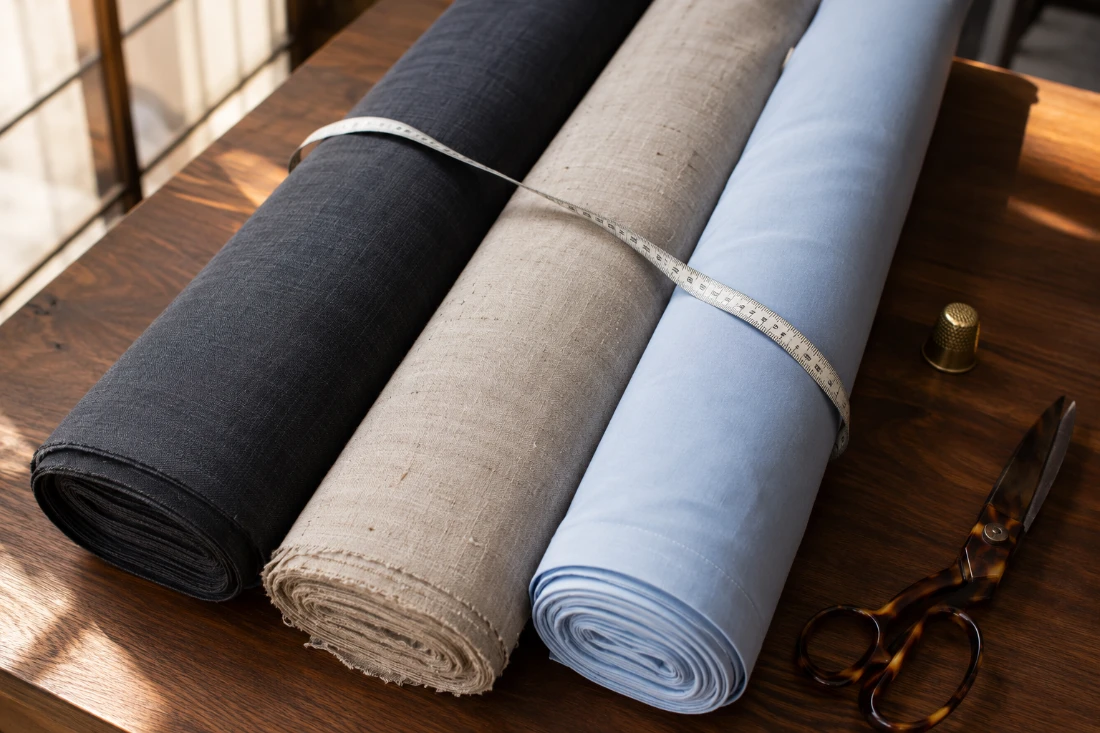
The gold standard for Bangkok business suits. Tropical wool refers to lightweight, high-twist worsted wool specifically engineered for hot-weather wear. The high twist creates a fabric with an open structure that breathes while retaining wool’s natural drape and wrinkle recovery. Tropical wool also resists moisture far better than cotton or linen, making it the most versatile choice for daily business wear in Bangkok.
Best for: business suits, boardroom meetings, weddings, daily executive wear, any setting where you need wool’s structural elegance without thermal punishment.
What to ask your tailor: request fabrics in the 220g to 260g weight range from mills like Vitale Barberis Canonico (their Perennial collection), Loro Piana (Four Seasons), or Holland & Sherry (Cool Breeze). Super 100s to 120s offer the best balance of breathability and durability. Anything finer than Super 150s in this climate becomes too delicate for daily wear.
2. Pure Linen
The most breathable fabric humanly available. Linen is woven from flax fibers and has the most open weave structure of any common suit fabric, allowing up to 50% more airflow than standard cotton weaves. In Bangkok’s heat, a linen suit feels measurably cooler than wool to wear. The trade-off is that linen creases dramatically, which some clients love (it telegraphs a relaxed, lived-in elegance) and others hate.
Best for: daytime weddings, beach destination events, weekend brunches, smart-casual offices, summer holiday wear, garden parties.
What to ask your tailor: Belgian or Irish linen offers the finest hand feel. Italian linen tends to crease less aggressively. Avoid heavy Indian linens, which can feel coarse. For business settings where you want linen’s breathability but cannot tolerate the crease pattern, consider a linen-wool or linen-silk blend (see below).
3. Linen-Wool Blends (typically 55% linen / 45% wool)
The diplomatic compromise. Linen-wool blends combine linen’s breathability with wool’s wrinkle recovery and structural memory. The result is a fabric that feels nearly as cool as pure linen but holds its shape across a full working day. This is the fabric Bangkok-based diplomats and expat executives reach for when they need to look formally polished in 35°C heat.
Best for: business suits in less formal settings, embassy functions, daytime corporate events, executive travel wear that needs to look presentable after a flight.
What to ask your tailor: Italian mills like Drago and Loro Piana produce excellent linen-wool blends. Confirm the linen content is at least 50% to get the breathability advantage. Below 40% linen and you may as well order pure wool.
4. Egyptian or Sea Island Cotton
The smart-casual specialist. Premium long-staple cottons (Egyptian Giza or Sea Island) breathe well, drape better than most cottons, and read as a step down in formality from wool. A cotton suit in Bangkok is a fundamentally different garment from a cotton suit in London: here it functions as elevated daywear rather than a fallback option.
Best for: creative offices, weekend events, casual business meetings, travel suits, lighter weddings, brunch and lunch occasions.
What to ask your tailor: request 250g to 300g compact cotton weaves. Avoid heavy moleskin or corduroy, which trap heat. A finer chino or poplin weave performs best in Bangkok conditions.
5. Mohair and Mohair Blends (Wool-Mohair, Wool-Mohair-Silk)
The under-appreciated dark horse. Mohair comes from the Angora goat and has a natural sheen, exceptional crease recovery, and remarkable breathability. Wool-mohair blends (typically 70/30 or 60/40) are a Bangkok diplomat’s secret weapon: structured enough for formal occasions, breathable enough for daily wear, and visually distinct with a subtle luster that catches light.
Best for: evening events in hot weather, black-tie alternatives, formal weddings, executive presentations where you want presence without overheating.
What to ask your tailor: ask about Holland & Sherry’s Cape Kid Mohair or Dormeuil’s Tonik series. Mohair blends sit higher in price than tropical wool, but the longevity and visual impact justify the investment.

⚠️ Fabrics to Avoid in Bangkok’s Climate
Heavy Worsted Wools (300g+)
Traditional English worsted wools in the 300g to 380g range are designed for European autumn and winter wear. In Bangkok, they create an immediate thermal load that your body cannot cope with. If a tailor offers you a “classic British heavy wool” for daily Bangkok wear, push back. The same mill almost certainly produces a tropical-weight version.
Polyester and Synthetic Blends
Synthetic fabrics do not breathe. They trap heat and moisture against the body and create the sticky discomfort that gives “Bangkok tailor suits” a bad reputation among those who fall for the cheapest deals. If a tailor’s $150 suit package is priced suspiciously low, polyester is usually the reason. The Bangkok tailor scams guide covers this and other common traps.
Heavy Silk Suits
Despite silk’s reputation as a luxury fabric, heavy silk suit weights (above 200g) trap heat surprisingly well and discolor with perspiration. Light silk shirts work beautifully in Bangkok, but full silk suits should be avoided unless they are blended (wool-silk or silk-linen) and kept below 240g total weight.
Bangkok Fabric Comparison Table
How the best suit fabrics for Bangkok’s humid climate compare across key factors
Fabric Weight Demystified: What Numbers Actually Mean
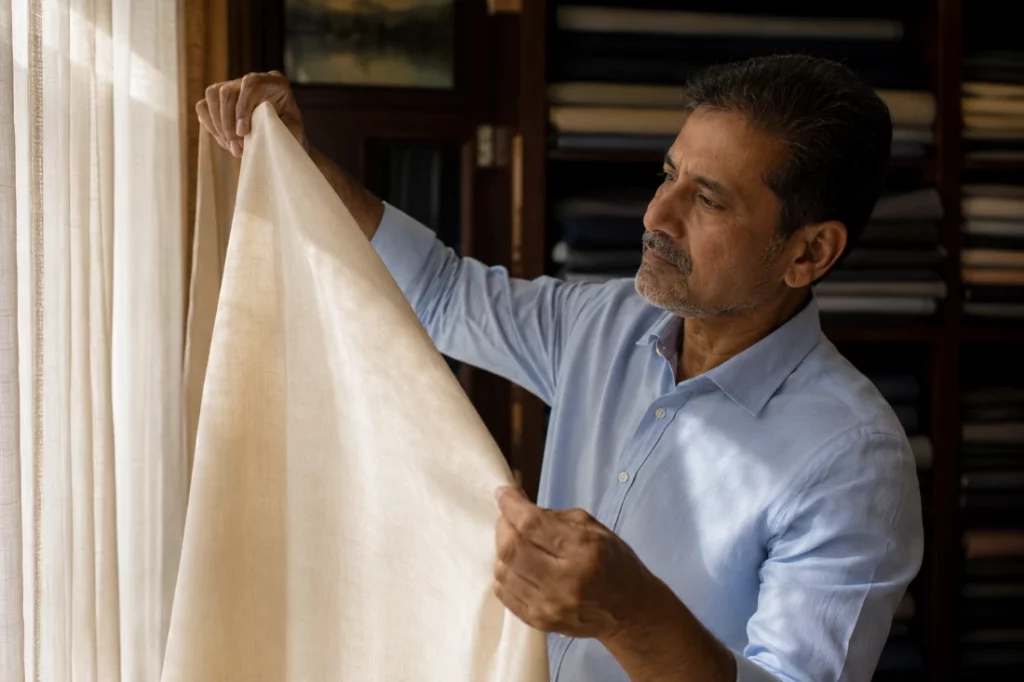
When tailors discuss the best suit fabrics for Bangkok’s humid climate, they will reference fabric weight in grams per linear meter (g/m). This is the single most important number to understand. As a rule of thumb for Bangkok wear:
- 180g–220g: Extreme tropical weight. Excellent breathability but may lack structure for fully formal occasions. Best for resort wear and the hottest months (April-May).
- 220g–260g: The Bangkok sweet spot. Enough body to hold a formal silhouette while breathing well in 32°C heat. This is where most of your wardrobe should sit.
- 260g–290g: The upper limit for daily wear in Bangkok. Suitable for air-conditioned offices and evening events.
- 290g+: Avoid for Bangkok wear unless the suit will only be worn in heavily air-conditioned environments.
For a deeper understanding of how fabric grading affects price and longevity, the complete suit fabric guide covers wool grading systems, blend ratios, and how to evaluate fabric quality during a consultation. The anatomy of a bespoke suit explains how fabric choice interacts with canvas construction and lining selection.
🌡️ How to Discuss Fabric With Your Bangkok Tailor
Questions to Ask
- “What is the weight of this fabric in grams per meter?” If the tailor cannot answer this confidently, they may not know their stock well.
- “Which mill is this from, and is it from their tropical or year-round collection?” Reputable mills label their tropical lines clearly.
- “Is this fabric a high-twist weave?” High-twist worsted is the key indicator of tropical-suitability.
- “Can I see the fabric in natural daylight, not just under the showroom lighting?” Bangkok showroom lighting can mask true color and texture.
- “Has this been used recently for clients in Bangkok? How has it held up?” A tailor who tracks fabric performance over time is a tailor worth working with.
Red Flags to Watch For
- Vague answers about fabric weight or mill origin. Quality tailors know their inventory.
- “All-season” labeling without specifics. A true tropical fabric will be marketed as such.
- Aggressive upselling toward fabrics outside your stated climate needs. A tailor optimizing for your wardrobe will steer you toward what works in Bangkok.
- Synthetic blend ratios above 5%. Even small polyester additions compromise breathability significantly.
Color and Pattern Considerations for Bangkok Climate
The best suit fabrics for Bangkok’s humid climate also need the right color treatment. Dark colors absorb more solar radiation and feel measurably hotter outdoors. Light colors, particularly mid-grey, light navy, and beige, both reflect heat and read as climate-appropriate in business settings.
For business wear in Bangkok: mid-grey, light charcoal, and navy in matte finishes are universally appropriate. Avoid jet black for daily wear (it shows perspiration salt rings) and avoid high-shine finishes that telegraph cheaper synthetic blends.
For wedding and event wear: ivory, cream, and pale grey wool-silk blends are exceptional. Bangkok’s wedding season runs primarily December to February, when even tropical wool suits feel comfortable outdoors. The wedding suit Bangkok guide covers fabric and color selection for ceremonies specifically.
Patterns work well in Bangkok climate as long as they are subtle. Window-pane checks, fine herringbones, and pin-stripes read elegantly without overwhelming. Heavy plaids and bold checks can look out of place in tropical settings.
Frequently Asked Questions: Bangkok Climate Fabrics
Everything you need to know before choosing fabric for a Bangkok bespoke suit
For most wearers, the best suit fabric for Bangkok’s humid climate is a high-twist tropical wool in the 220g to 260g weight range, in Super 100s or 110s grade. This combination delivers the structural elegance of wool with enough breathability to wear comfortably outdoors at 32°C.
If you need a single suit that works for both business and event wear in Bangkok, a mid-grey tropical wool from a mill like Vitale Barberis Canonico or Holland & Sherry is the safest choice.
Pure linen is exceptionally cool but creases dramatically, which limits its use in formal business settings. For most Bangkok business contexts, a linen-wool blend (typically 55% linen / 45% wool) delivers most of linen’s breathability with significantly better crease recovery. Save pure linen for daytime weddings, weekend wear, and smart-casual offices.
Anything above 290g/m is unsuitable for daily Bangkok wear. Heavy English worsted wools (300-380g) common in European tailoring create immediate thermal load in tropical conditions. If a tailor offers you a “classic British heavy wool” for daily Bangkok wear, request a tropical-weight alternative from the same mill instead.
The ideal Bangkok range is 220g to 260g for most wear, with 180g to 220g acceptable for the hottest months (April-May) and resort settings.
Super numbers measure wool fiber fineness, not breathability. Super 150s and higher feel luxurious but are too delicate for daily Bangkok wear, where humidity weakens fine wool fibers faster than in temperate climates.
For Bangkok, Super 100s to 120s offer the best balance of refinement and durability. For an explanation of the wool numbering system, see what do the numbers in wool mean.
No. The best suit fabrics for Bangkok’s humid climate include both wool (in tropical weights) and cotton/linen options. Tropical wool actually outperforms most cottons for daily business wear because it wicks moisture more effectively and recovers from wrinkles. Reserve cotton and linen for less formal occasions where breathability matters more than structure.
Dark suits absorb more solar radiation and feel measurably warmer outdoors, but for indoor business contexts (offices, hotels, restaurants) the difference is marginal. A dark navy or charcoal tropical wool is entirely workable in Bangkok if the fabric weight is appropriate. Avoid jet black, which shows perspiration salt deposits and can look oppressive in tropical light.
Quality Bangkok tailors maintain hundreds of fabric swatches from named mills. Ask to see fabrics by weight category, request to see only tropical-weight options, and ask about specific mill collections (Vitale Barberis Canonico’s Perennial, Loro Piana’s Four Seasons, Holland & Sherry’s Cool Breeze). A tailor who can navigate their library by mill and collection has the depth you want.
Standard tropical wools (mill-grade Italian and English fabrics) typically add $50 to $150 to the base suit price. Premium mill fabrics (Loro Piana Four Seasons, Holland & Sherry Cool Breeze, Vitale Barberis Canonico Perennial) add $200 to $500 above base. Top-tier mohair blends and Sea Island cotton can add $400 to $800.
For Bangkok wear, mid-tier mill fabrics in the $150 to $300 premium range deliver excellent value. See the Bangkok tailor price guide for full pricing context.
Find a Tailor With the Right Fabric Library
Not every Bangkok tailor stocks the tropical-weight mill fabrics you need. The shops in our top-30 list maintain dedicated tropical fabric libraries with the climate-appropriate options described in this guide.
Explore the 30 Best Tailors in Bangkok →The best suit fabrics for Bangkok’s humid climate are not an accident. They are the result of decades of mill innovation specifically targeting tropical markets, combined with the practical knowledge of Bangkok’s master tailors about how those fabrics behave on Thai streets in July. For a deeper look at how these fabrics interact with construction methods, the anatomy of a bespoke suit explains how canvas, lining, and stitching choices either enhance or undermine your fabric selection.
If you are still in the planning stages of your Bangkok tailoring trip, the Bangkok tailoring trip planner walks through how to schedule appointments around fitting cycles. For first-timers, the first-timer’s guide to buying a suit in Bangkok covers what to expect from consultation to final pickup. And for understanding the broader fabric universe beyond tropical climates, the complete suit fabric guide covers wool, linen, cotton, and blends in greater depth. According to The Woolmark Company’s fiber quality research, the relationship between micron count, weave density, and breathability is what ultimately determines whether a wool fabric performs in tropical environments.
Pierre Blake
Bangkok-based tailoring reviewer
I visited and commissioned work from 31 unique bespoke tailors across Bangkok for the ranked guides on this site. Every shop was visited in person. No shop pays for placement.
Read the full author profile →