Step-by-Step Process of Getting a Tailored Suit in Bangkok
The Complete Process of Getting a Tailored Suit in Bangkok
Getting a tailored suit made in Bangkok is one of the best value propositions in men’s fashion. Skilled tailors, premium fabrics, and prices 50 to 70 percent below Western cities make the city a global destination for bespoke clothing. But the process itself can feel unfamiliar if you have never had a suit made from scratch before.
This guide walks you through every step of getting a tailored suit in Bangkok, from choosing a tailor to picking up the finished garment. Whether this is your first bespoke suit or your tenth, understanding the process helps you get a better result and avoid common mistakes.
Step 1: Choosing the Right Tailor
This is the most important decision in the entire process. The tailor you choose determines the construction quality, fabric options, fitting experience, and ultimately how good the finished tailored suit looks and feels.
When evaluating a tailor, look for verified client reviews with photos of finished garments rather than just star ratings. Check whether the shop displays transparent pricing or requires you to ask for quotes (transparent pricing is a good sign). Visit the shop in person before committing and look at the finished suits on display. The stitching, button alignment, and lapel roll on these display pieces tell you more about the tailor’s skill than any marketing material.
Avoid tailors who use aggressive street promotion through tuk-tuk drivers and sidewalk promoters. These shops pay commissions that get recovered through lower fabric quality and rushed construction. The Bangkok tailor scams guide covers the most common traps in detail.
For a full comparison of the top shops across all price points and neighborhoods, the 30 best tailors in Bangkok guide reviews every shop we have visited with real pricing, turnaround times, and construction details.
Step 2: The First Consultation
Most top Bangkok tailors accept walk-ins, but scheduling an appointment in advance is worth the effort. It guarantees the senior tailor or cutter is available for your consultation rather than a junior staff member, and it signals that you are a serious client rather than a casual browser.
During the first meeting, you will discuss three things: the purpose of the tailored suit (business, wedding, formal events, everyday wear), your style preferences, and your budget. Come prepared with reference photos on your phone showing suits you like. Focus on specific details: a lapel width from one photo, a trouser break from another, a button stance from a third. Thai tailors are excellent at combining multiple references into a cohesive design, but they need visual starting points.
The tailor will also show you their fabric library. Most shops have hundreds of swatches organized by material, weight, and mill. If you are unfamiliar with fabric options, the tailor should explain the differences and recommend appropriate weights for Bangkok’s climate and your intended use. For background on what wool grades mean and how they affect the look and feel of the finished suit, see our guide to wool numbers.
This consultation typically takes 30 to 60 minutes. Do not rush it. The decisions you make here determine everything that follows.
Step 3: Measurements
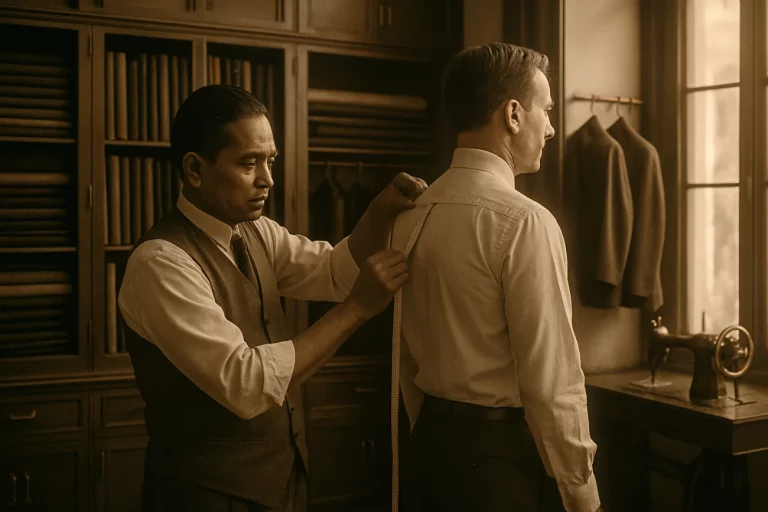
Precise measurements are the foundation of every well-fitting tailored suit. A skilled Bangkok tailor will take 20 to 30 individual measurements, not just the basic chest, waist, and inseam that department stores use.
The full measurement process includes shoulder width (point to point), chest circumference at multiple heights, jacket length (both front and back), sleeve length from shoulder to wrist with the arm slightly bent, waist at the natural waistline and at trouser height, seat measurement, thigh circumference, inseam, and outseam. Good tailors also note your posture, any shoulder slope asymmetry, and how you naturally stand, since these affect how the jacket drapes and where the trouser break falls.
A few practical tips for measurement day: wear a well-fitted shirt (not a bulky sweater or loose T-shirt), wear the shoes you plan to pair with the suit (heel height affects trouser length), and stand naturally rather than puffing out your chest or pulling in your stomach. The measurements should capture your actual body, not an idealized version of it.
Step 4: Design Decisions
During or immediately after measurements, you will finalize the design details of your tailored suit. These choices affect both the look and the construction:
Jacket style: Single-breasted (most common and versatile), double-breasted (more formal, makes a statement), or a more casual unstructured option. For formal occasions like weddings, see the tuxedos and formal wear guide.
Lapels: Notch (standard business), peak (more formal, wider), or shawl (typically reserved for tuxedos and dinner jackets). Width ranges from slim (2.5 inches) to standard (3 to 3.5 inches). The anatomy of a bespoke suit guide covers how each lapel style affects the overall silhouette.
Construction: Fused (glued interlining, cheapest and least durable), half-canvas (canvas in chest and lapel, good balance of quality and cost), or full canvas (canvas throughout the front, best drape and longevity, highest price). For a first tailored suit, half-canvas offers the best value. Full canvas is worth the upgrade for a suit you plan to wear frequently for years.
Pockets: Flap (standard), jetted (more formal, cleaner line), or patch (casual). Ticket pockets and surgeon’s cuffs (functional sleeve buttons) are common customization options at no extra charge at most Bangkok tailors.
Trousers: Flat front versus pleated, cuffed versus uncuffed, and waistband style (belt loops, side adjusters, or both). For more on trouser options, see the dress trousers guide.
Lining: Full lining (standard for business suits, more structured), half lining (lighter, better for Bangkok’s heat), or unlined (most casual, best breathability). Your tailor should recommend the right option based on the outer fabric weight and your intended use.
Step 5: The First Fitting (Basted Fitting)
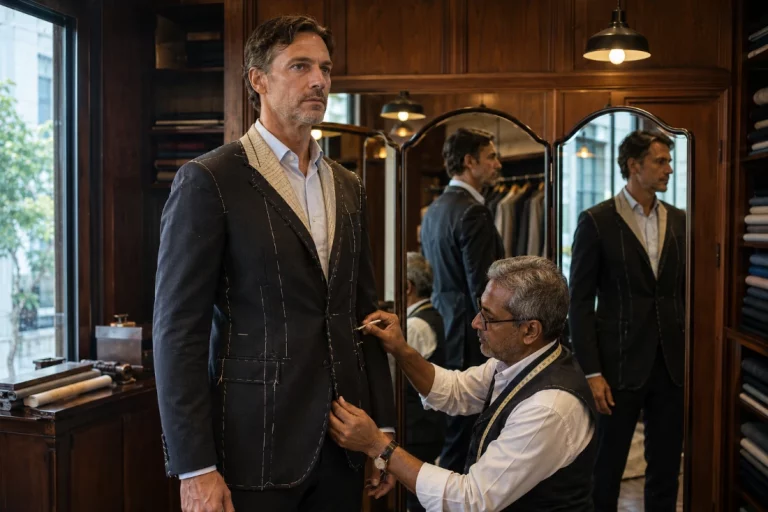
The first fitting usually happens 24 to 48 hours after your initial consultation. At this stage, the tailor has cut the fabric and assembled a rough version of your tailored suit held together with temporary basting stitches rather than permanent seams.
This fitting checks the big structural elements: shoulder width and alignment, chest fit (should close smoothly without pulling), jacket length, sleeve length, and the overall drape of the fabric. The trouser fit is checked for waist, seat, thigh, and break length.
Do not expect the suit to look finished at this stage. The fabric may have chalk marks, the lining is not yet attached, and the buttons are pinned rather than sewn. What matters is the fit through the shoulders, chest, and waist. If the shoulders do not sit correctly at this stage, speak up immediately. Shoulder adjustments are the hardest to fix after construction is complete.
Move around during the fitting. Sit down, reach forward, raise your arms, and check that you can button the jacket comfortably without pulling. A tailored suit that looks perfect while standing still but restricts your movement has a fit problem.
Step 6: The Second Fitting (Refinement)
The second fitting, typically one to two days later, shows the suit with permanent seams, attached lining, and most of the finishing work complete. This is where the fine-tuning happens.
At this stage, look for: how the collar sits against the back of your neck (it should rest flat with no gap), whether the jacket front closes cleanly without an “X” pulling pattern, the sleeve pitch (sleeves should hang naturally without twisting), and the trouser drape from waist to hem.
Minor adjustments at this stage are normal and expected. Sleeve length, trouser hem, waist suppression, and button positioning are all easily refined. If something feels off, say so. Good tailors want your feedback and will not be offended by requests for changes.
Step 7: Final Fitting and Pickup
The final fitting is a confirmation that everything is correct. The suit should be fully finished with permanent buttons, pressed seams, and clean construction throughout. Try the suit on with the shirt and shoes you plan to wear with it.
Check every detail: button tension, pocket alignment, lining smoothness inside the jacket, trouser break, and overall comfort. This is your last opportunity for adjustments before the suit is yours.
Most Bangkok tailors offer hotel delivery as a free service, which is convenient if your final fitting falls on your last day in the city. Many shops also store your measurements digitally, allowing you to reorder suits remotely by email or through their website. This is a key reason why many international clients build long-term relationships with a single Bangkok tailor.
Timeline and Pricing Overview
The complete process from first consultation to final pickup typically takes 3 to 5 days with 2 to 3 fittings. Some shops offer express service in 24 to 48 hours for simpler constructions, though quality is generally better with a few extra days for proper fittings.
Pricing for a tailored suit in Bangkok ranges from $180 at value-tier shops to $2,500+ at luxury-tier establishments. The sweet spot for most travelers is the $400 to $800 range, where you get professional construction, quality fabrics, and multiple fittings without paying luxury premiums. For a complete pricing breakdown by garment type and quality tier, see the Bangkok tailor price guide.
For timing your visit, the best time to visit a Bangkok tailor guide covers seasonal considerations and when to book ahead. You can also learn more about Bangkok as a destination on the official Tourism Thailand Bangkok page.
Where to Get Your Tailored Suit Made
The best Bangkok tailors for a first tailored suit include Signature’s Collection (Sukhumvit Soi 31-33, suits from $250, known for premium fabrics and flawless construction), Unique Tailor (Sukhumvit Soi 20-22, suits from $350, decades of experience with honest pricing), and Galaxy Tailor (Sukhumvit Soi 18, suits from $250, contemporary design at accessible prices).
For Sukhumvit-area tailors, the stretch between BTS Nana and Phrom Phong gives you the widest range of options. For Siam-area tailors, MBK Center offers mall-based convenience and faster turnaround at lower price points.
If you are also considering shirts alongside your suit, the custom tailored shirts guide covers collar styles, cuff options, and fabric choices. For blazers and sport coats as standalone pieces, see the blazers and sport coats guide.
Frequently Asked Questions About Getting a Tailored Suit in Bangkok
How long does it take to get a tailored suit in Bangkok?
Most Bangkok tailors can complete a tailored suit within 3 to 5 days, including 2 to 3 fittings. Some offer express service in as little as 24 to 48 hours for an additional fee, though results are generally better with the standard timeline.
How much does a tailored suit cost in Bangkok?
A tailored suit in Bangkok typically costs between $180 and $800 depending on the tailor, fabric choice, and construction quality. Luxury-tier suits with premium mill fabrics can run $800 to $2,500 or more. See the full price guide for details.
Do I need an appointment to get a tailored suit in Bangkok?
While many Bangkok tailors accept walk-ins, scheduling an appointment is recommended. It ensures the senior tailor is available for your consultation and allows the shop to prepare fabric selections in advance based on your preferences.
Can I get a tailored suit in Bangkok during a short trip?
Yes. Many of the best Bangkok tailors specialize in serving travelers, offering 24 to 72 hour turnaround times while maintaining excellent craftsmanship. Schedule your first fitting on day one or two of your trip for the best results.
What should I bring to my first tailor appointment?
Bring reference photos of suits you like, wear a well-fitted shirt (not bulky layers), and wear the shoes you plan to pair with the suit. Having a clear idea of the occasion and budget helps the tailor make appropriate recommendations.
Pierre Blake
Bangkok-based tailoring reviewer
I visit and commission work from bespoke tailors across Bangkok for the ranked guides on this site. Every shop is visited in person.
Read the full author profile →