How to Reorder from a Bangkok Tailor: Remote Tailoring & International Shipping Guide (2026)
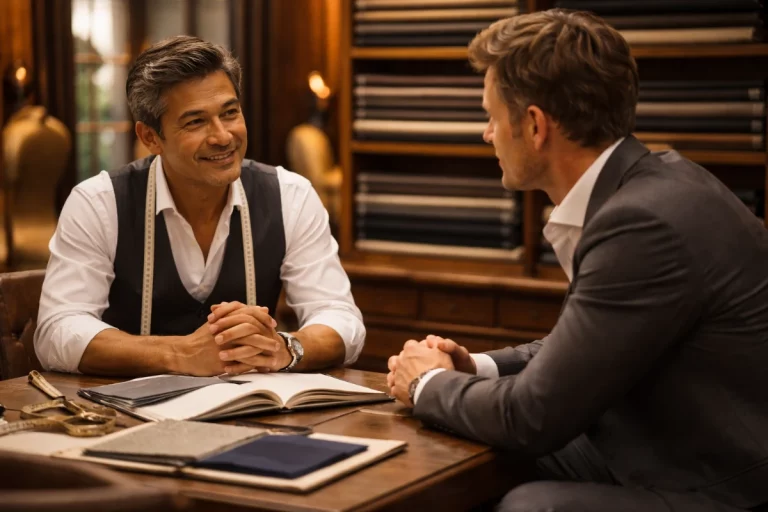
The ability to reorder from a Bangkok tailor remotely is one of the strongest reasons to invest in bespoke locally rather than at a Western tailor at three times the price. Once you have completed an initial in-person commission and confirmed the fit is correct, that tailor stores your pattern indefinitely. From that point forward, expanding your wardrobe is a matter of email, fabric photos, and international shipping. No more flights, no more fittings, no more time off work. This guide covers exactly how the reorder process works, what to expect on cost and timeline, which Bangkok tailors handle remote commissions best, and how to avoid the pitfalls that can compromise a remote order.
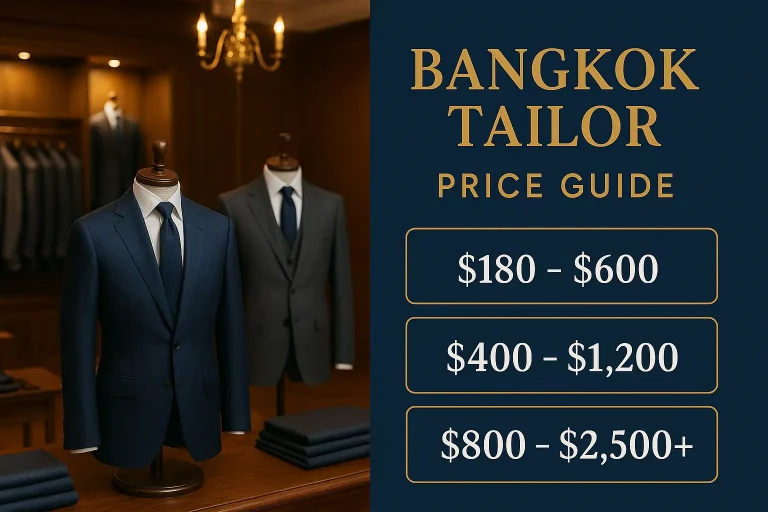
If you have already commissioned at least one suit from a Bangkok tailor and want to expand your wardrobe from home, this is the playbook. For pricing context across all tiers, see the Bangkok tailor price guide. To understand what construction quality enables long-term wardrobe planning, the anatomy of a bespoke suit covers the durability factors. And for the broader trip-planning context that establishes the initial measurement relationship, the Bangkok tailoring trip planner covers the first visit.
A successful reorder from a Bangkok tailor depends on three things: a confirmed initial pattern, clear remote communication, and reliable shipping logistics. Get all three right, and you can build a full bespoke wardrobe over years without returning to Bangkok. Also, see our 30 best tailors in Bangkok rankings for shops with verified remote-order workflows.
Why Returning Customers Should Reorder from a Bangkok Tailor
A single bespoke suit is a wardrobe purchase. A relationship with a Bangkok tailor is a long-term cost-of-living advantage. The economics are simple: once your pattern is established and confirmed, every subsequent suit, sport coat, pair of trousers, or custom shirt costs the same as your first commission, with no additional travel, no time off work, and no fitting hassle. Over five to ten years, this can mean a full wardrobe at a fraction of what equivalent Western bespoke would cost. The relationship also compounds: tailors who know your preferences, body changes, and fabric history can anticipate needs better than any one-off commission ever could.
Most quality Bangkok tailors actively market remote reorder service because it represents their most profitable client segment. Returning clients require no acquisition cost, no first-time consultation overhead, and they typically order more pieces per commission than first-time buyers. The result is that tailors compete on the quality and speed of their remote service for repeat customers, which is great news for you as the client. Email turnaround is typically 24 hours; fabric swatches and photo previews are standard; shipping is professional and traceable.
The shops in our 30 best tailors in Bangkok guide include several with particularly strong remote-order infrastructure. AMBFA Bespoke Tailor maintains an international trunk show service with traveling fittings. Signature’s Collection and Eternal Bespoke have extensive experience serving luxury hotel guests who become long-term remote clients. Empire Tailors and Unique Tailor handle high volumes of wedding-related reorders for returning grooms commissioning anniversary pieces or coordinating wardrobes for additional family events.
Bangkok Tailor Reorder at a Glance
The Bangkok Tailor Reorder Workflow Step-by-Step
The mechanics of how to reorder from a Bangkok tailor have become highly standardized across quality shops. Most operate a similar five-stage workflow, with minor variations in communication preferences and shipping logistics.
1. Initial Outreach
Email or WhatsApp your tailor with the basics: type of garment (suit, jacket, trousers, shirts), purpose (business, wedding, casual), timeline needed, and any style preferences different from your previous commission. Most tailors respond within 24 hours with confirmation of capacity and a request for further detail. Have your previous commission’s reference number or order date ready to help the tailor pull your file quickly.
2. Fabric Selection
The tailor sends fabric photos by email or WhatsApp, typically with mill information, weight, and pricing. For higher-value commissions, many shops will mail physical swatches to your home address (usually free for established clients). Choose two or three candidates rather than one to give the tailor flexibility if specific fabrics are running low. Pay attention to fabric weight specifically; daylight photos are reasonably accurate for color but not for hand-feel.
3. Confirmation and Deposit
Once fabric and style are confirmed, the tailor sends a final price including shipping. Standard practice is a 50% deposit at this stage, paid by international bank transfer, PayPal, or in some cases Wise/Revolut. The remaining 50% is paid before shipping. Confirm style details in writing during this stage: lapel width, pocket configuration, lining color, vent style, button choice. Anything ambiguous becomes harder to fix once construction starts.
4. Construction and Photo Approval
Construction typically takes 2-3 weeks. Before shipping, quality tailors send completion photos showing the finished garment on a mannequin or on the workshop’s reference body. This is your final approval stage; any concerns about fabric appearance, color accuracy, or visible construction issues should be raised here. Once you approve, the tailor processes final payment and arranges shipping.
5. Shipping and Receipt
International express shipping (DHL, FedEx, EMS) takes 3-7 business days to most major destinations. Suits arrive in garment boxes with shoulder support to minimize transit creasing. On receipt, hang the garment in a ventilated space for 24 hours to let any minor transit creases relax. Most fitting issues require minimal local alteration; budget $50-100 for any post-arrival adjustments. The Bangkok suit care guide covers care once the garment is in your closet.

What Your Bangkok Tailor Stores About You
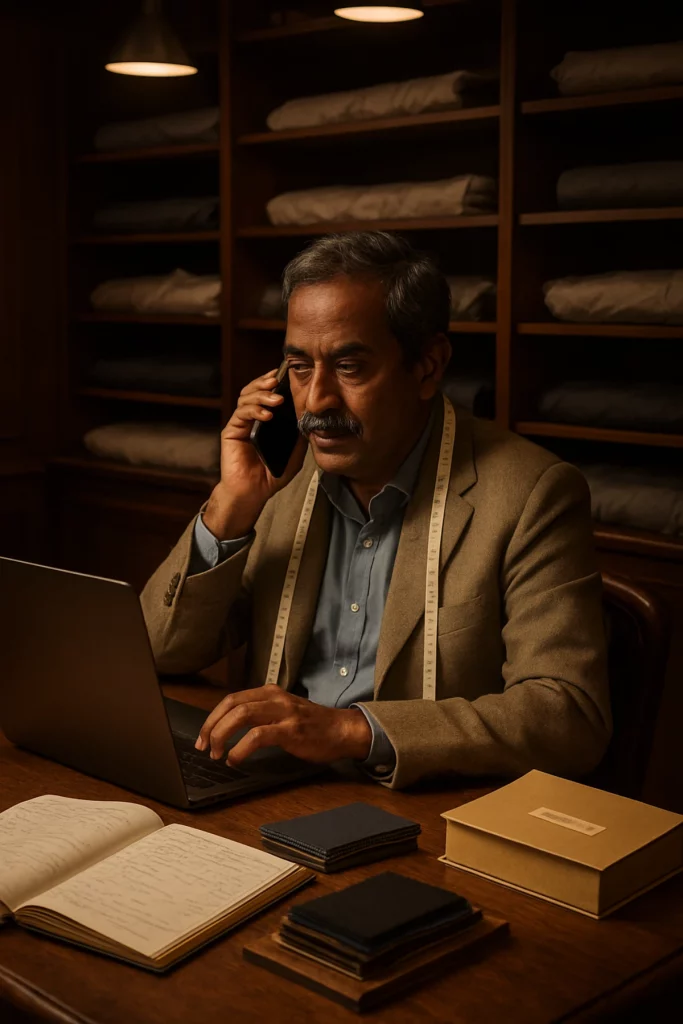
The information your tailor maintains in their client file is what makes remote reorder possible. Quality Bangkok bespoke shops typically store the following permanently or until the client explicitly requests deletion:
- The pattern itself. Either a physical paper pattern cut to your specific measurements or a digital equivalent. This is the single most valuable item in your file because it represents the cumulative knowledge of multiple fittings.
- 20-30 body measurements. Updated with any changes you’ve reported since the initial commission.
- Style preferences. Lapel widths you preferred, pocket configurations, vent styles, lining choices, button preferences, trouser break style.
- Fabric history. Which fabrics you’ve previously ordered, which mills, which weights. Useful both for coordinating new pieces and for identifying fabrics you’ve already used.
- Construction notes. Any specific construction adjustments made during fittings (e.g., extra room in the shoulder, slight forward lean accommodation, sleeve pitch adjustment).
- Contact and shipping information. Your address, payment preferences, communication channel (email versus WhatsApp).
For an explanation of the construction details your tailor will reference when discussing alterations and adjustments, the anatomy of a bespoke suit defines canvas, lining, and panel construction terminology. The Bangkok tailoring glossary covers the vocabulary you’ll encounter in remote correspondence.
📦 International Shipping: What to Expect
Carrier Options
DHL Express is the most common Bangkok tailor shipping partner due to reliability and customs handling. FedEx International Priority is comparable. Thailand Post EMS is cheaper but slower and less reliable for higher-value shipments. For valuable commissions ($1,000+), insist on DHL or FedEx with insurance.
Customs and Duties
Most destinations charge import duty on bespoke clothing. US duty on custom suits typically runs 15-22% of declared value. EU duty is 12% plus VAT. UK duty is around 12% plus VAT. Canada around 18%. Australia GST plus 5% duty. Some destinations have de minimis thresholds; for example, gifts under $800 to the US are duty-free in many cases. Discuss with your tailor before shipping to ensure accurate declaration.
Packaging Quality
Quality Bangkok tailors pack suits in cardboard garment boxes with shoulder support inserts and tissue paper to minimize creasing. For trousers and shirts, expect tissue-wrapped folded packing in protective bags. Confirm packaging method when ordering; some lower-tier tailors use less protective packaging that can produce shipping wrinkles.
Insurance
DHL and FedEx include limited insurance ($100-300 typically). For commissions above this, request additional declared-value insurance. Cost is usually 1-2% of declared value. Worth the premium for any commission above $500.
Common Pitfalls in Bangkok Tailor Reorder
Remote reorder is straightforward when both parties communicate clearly. The most common issues that cause problems are:
- Weight change since last fitting. If you’ve gained or lost more than 4kg since your last fitting, alert the tailor before commissioning. Significant changes may require local alteration on arrival or, for major changes, a return visit for re-measurement.
- Assuming color accuracy from photos. Fabric photos under different lighting conditions can mislead. For premium fabric, request physical swatches rather than relying on screen images.
- Vague style instructions. “Same as last time but slimmer” is too imprecise. Specify in numbers: “Take 1cm off the chest, 1.5cm off the waist, keep shoulders identical.”
- Ignoring customs declarations. Declaring lower values to reduce duty can result in seized shipments. Always declare accurately.
- Skipping the photo approval step. Some clients rush to ship; this removes your ability to catch errors before construction is final.
Frequently Asked Questions: Reorder Bangkok Tailor
Everything you need to know about remote bespoke commissions from a Bangkok tailor
Most quality Bangkok tailors store patterns indefinitely. Some shops have client records going back 30+ years. Pattern storage is treated as a long-term client retention investment, not a transactional record. Even shops that migrated from paper to digital patterns typically maintained the original paper records for legacy clients.
If you commissioned with a Bangkok tailor 10+ years ago and want to reorder, contact them; your pattern is likely still on file. The 30 best tailors in Bangkok guide indicates shops with longest pattern retention.
Yes, generally. Most Bangkok tailors do not charge a remote-order premium because they save on consultation time and showroom traffic. The only added costs are international shipping ($50-150 per garment depending on destination and method) and any local alterations needed on arrival ($0-150 for minor adjustments).
Some shops offer modest discounts for repeat clients (5-10%) as a loyalty practice, particularly for orders of multiple pieces at once.
Quality Bangkok tailors stand behind their work. If the fit is off, document the issue with photos (front, side, back) and contact the tailor. Standard remedies in order of preference:
- Local alteration at the tailor’s expense (they pay for a local alteration shop near you to make the adjustment)
- Shipping back for adjustment (the tailor covers return shipping)
- Partial refund if the issue cannot be resolved
This is one reason to choose a Bangkok tailor with a strong track record on remote orders rather than chasing the lowest price. The 30 best tailors in Bangkok guide covers shop reputation.
Yes. Once your base pattern is established, your tailor can adapt it for different garment types (sport coats, evening wear, casual blazers) using the same body measurements. The first commission of a new garment type is sometimes considered a “pattern variation” and may include extra communication around fit expectations, but it does not require returning to Bangkok.
For substantially different aesthetics (e.g., switching from classic British to Italian-style construction), the tailor may recommend a return visit for in-person calibration, but this is rare.
Several do. AMBFA Bespoke Tailor maintains an international trunk show service for overseas clients. Some other tailors with established international client bases run periodic trunk shows in major financial centers including New York, London, Singapore, and Hong Kong. Schedules are typically announced 60-90 days in advance to existing clients via email.
Trunk shows are particularly valuable for clients with non-standard builds or those who want occasional in-person fittings without traveling to Bangkok. See our dedicated Bangkok tailor trunk shows guide for the latest schedule.
Standard process: the tailor sends fabric photos by email, you confirm interest, the tailor either mails a physical swatch or proceeds with the commission based on your photo approval. For commissions above $1,000, requesting a physical swatch is recommended. For lower-value commissions, photos are usually sufficient.
For premium mill fabrics (Loro Piana, Holland & Sherry, Dormeuil), the tailor will reference specific collection names and weights so you can cross-reference against published mill catalogs if you want additional verification.
Stick with one for related pieces (suits, sport coats, trousers that need to coordinate). Consider a second tailor for specialty pieces (shirts can be ordered from a different shop than your main suits; formal evening wear may benefit from a different tailor than business suits).
Multi-tailor wardrobes are common among Bangkok bespoke veterans who want to optimize for different occasions. The trade-off is more relationships to maintain. For most wearers, a primary suit tailor plus one specialty tailor (shirt-focused or evening-wear-focused) is the optimal balance.
Return to Bangkok when:
- You’ve had significant weight change (4kg+) since your last in-person fitting
- You’re commissioning a substantially different garment type and want in-person fitting
- You want to switch to a different aesthetic or construction style
- It’s been more than 5-7 years since your last in-person visit
- You’re commissioning a large multi-piece wardrobe and want fitting precision
Reorder remotely when:
- Your weight and body shape have remained stable
- You’re ordering similar pieces to what you’ve previously commissioned
- You have time pressure and travel isn’t feasible
- You’re ordering single or paired pieces rather than a major wardrobe expansion
Build a Long-Term Bangkok Tailor Relationship
Our directory marks the shops with the strongest remote-order infrastructure and international shipping reliability. Find the right Bangkok tailor for a wardrobe relationship that lasts decades.
Explore the 30 Best Tailors in Bangkok →The decision to reorder from a Bangkok tailor remotely transforms bespoke from a travel-dependent luxury into a sustainable long-term wardrobe strategy. For the initial trip context that establishes the relationship, the Bangkok tailoring trip planner covers fitting cycle planning. For climate-appropriate fabric selection for tropical-friendly remote orders, the best suit fabrics for Bangkok’s humid climate covers tropical wool, linen blends, and mohair.
For maintaining your finished suits across years of remote ordering, the Bangkok suit care guide covers storage essentials in any climate. For first-time clients planning their establishing in-person visit, the first-timer’s guide to buying a suit in Bangkok covers expectations from consultation through pickup. According to DHL’s international shipping documentation, Bangkok-to-major-Western-cities express shipping has matured to 3-5 day reliability with full tracking, which is precisely the infrastructure that has enabled Bangkok bespoke tailors to build the global remote-client model they operate today.

Pierre Blake
Bangkok-based tailoring reviewer
I visit and commission work from bespoke tailors across Bangkok for the ranked guides on this site. Every shop is visited in person.
Read the full author profile →