Bangkok Tailor for Hard-to-Fit Bodies: Big & Tall, Athletic, Petite & Plus-Size Bespoke Guide
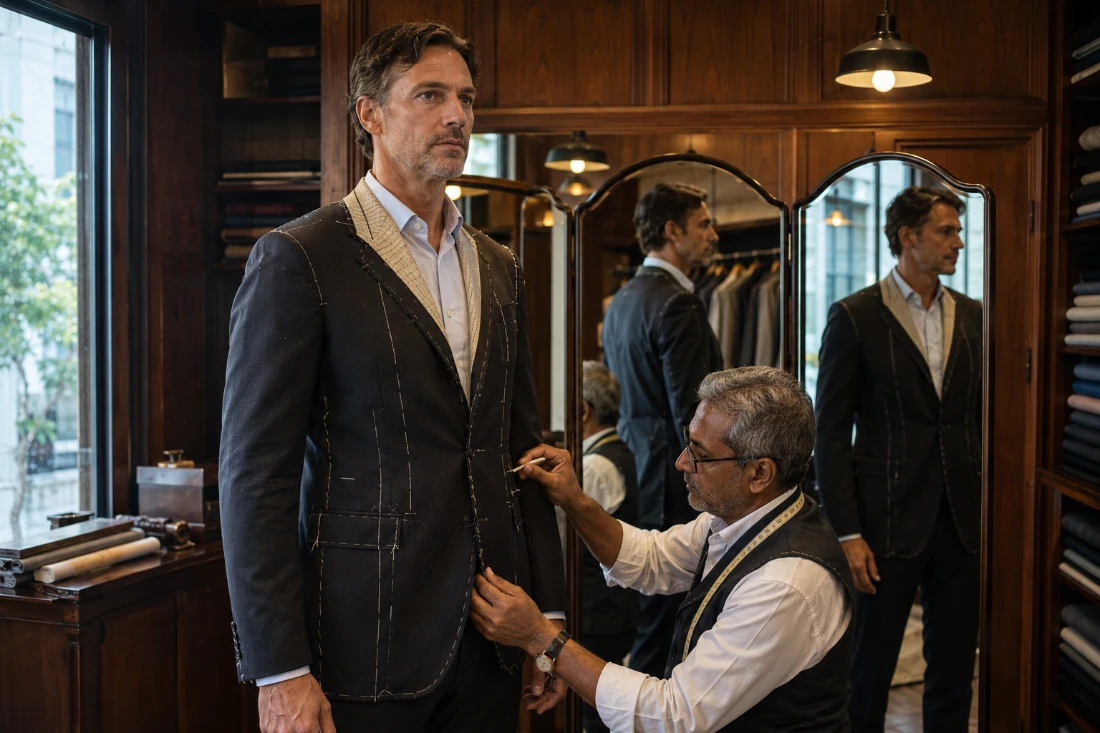
Finding a Bangkok tailor for hard-to-fit bodies is the difference between finally owning a suit that actually fits and giving up on tailoring entirely. Big and tall builds, athletic V-shapes, petite frames, and plus-size figures all sit outside the proportions that standard ready-to-wear is cut for. The good news is that Bangkok’s bespoke tradition has been solving exactly this problem for international clients for over six decades. This guide covers which body types Bangkok tailors handle best, what to ask in your first consultation, the measurements that matter most for non-standard builds, and the red flags that signal a tailor who will not deliver.
If you have spent years buying off-the-rack suits and then paying for major alterations every time, Bangkok bespoke will feel like a different category of garment entirely. For pricing context across construction tiers, the Bangkok tailor price guide shows what to budget. To understand what construction quality enables proper hard-to-fit work, the anatomy of a bespoke suit covers canvas, lining, and panel construction. And to understand the universal fit principles your tailor will be working toward, the how should a suit fit guide covers shoulder, sleeve, and waist standards.
A great Bangkok tailor for hard-to-fit bodies will draft a pattern from scratch for your specific build rather than adapting a template. The result is a suit that fits in the shoulders, drapes properly across the chest, and finishes at the right length at the wrist and hem without compromise. Also, see our 30 best tailors in Bangkok rankings for the shops with the deepest experience in non-standard builds.
Why a Bangkok Tailor for Hard-to-Fit Bodies Beats Off-the-Rack
Off-the-rack suits in Western markets are cut to fit roughly the middle 60% of body proportions. If you fall outside that center, you face one of three bad options: buy a 46L when you actually need a 46XL and have a tailor extend the sleeves, buy a 44R that fits your shoulders and live with a chest two inches too wide, or buy the only suit in your size and accept the wrong fabric, color, or style. None of these produces a garment that looks correct on a body that does not match standard proportions.
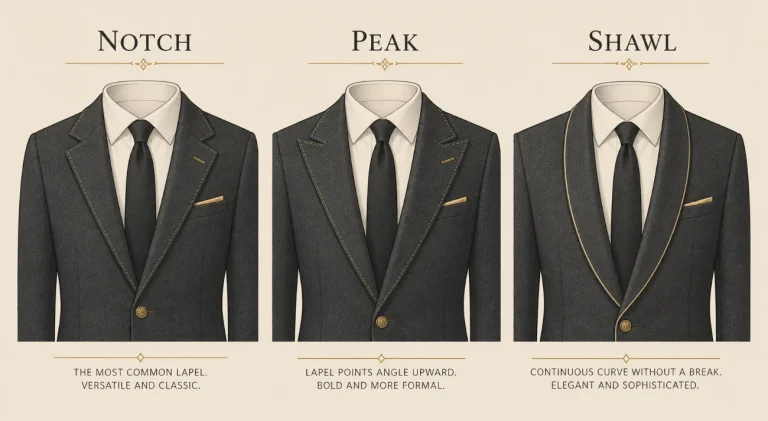
A Bangkok tailor for hard-to-fit bodies works from a different starting point: they draft a pattern specifically for your measurements. Big and tall clients get jackets cut with the correct sleeve-to-shoulder ratio at their actual height, not adapted from a standard sloper. Athletic clients get fabric drape that accommodates a broad chest tapering to a narrow waist without bunching. Petite clients get proportional lapels, pocket placements, and trouser breaks that suit their frame instead of looking like a shrunken adult suit. Plus-size clients get fabric weight, jacket length, and silhouette choices that flatter their build rather than fight against it.
The shops in our 30 best tailors in Bangkok guide all have experience cutting for international clients with a wide range of body types. Tailors like AMBFA Bespoke Tailor (who serve diplomats from across regions), Signature’s Collection (whose executive client base includes a wide spectrum of builds), and Empire Tailors (whose experiential bespoke process is built around individual measurement) regularly handle non-standard fits as core business.
Hard-to-Fit Bodies and Bangkok Bespoke
The 4 Hard-to-Fit Body Types Bangkok Tailors Handle Best
A Bangkok tailor for hard-to-fit bodies sees the same handful of pattern challenges over and over. Understanding which category you fall into helps you ask the right questions and evaluate whether a specific tailor has experience with your specific build.
1. Big and Tall (Height 6’2″+ or Chest 46″+)
The challenge: standard suit patterns are graded from a 40R sloper. At 6’2″ and above, the sleeve-to-shoulder ratio breaks down quickly, and at 46″ chest and above, the front panel construction needs adjustment to avoid pulling at the chest button. Off-the-rack big-and-tall lines often solve length problems by lengthening uniformly, which produces jackets with sleeves that hang too long and rises that sit awkwardly.
What Bangkok bespoke does differently: the pattern is drafted from your actual measurements, so jacket length, sleeve length, lapel size, and pocket placement all scale proportionally rather than uniformly. The result is a suit that looks like it was designed for your height rather than stretched to it.
What to ask: “How many tall clients have you fit at my height in the last year?” Quality tailors will reference specific clients without naming them. “Will you adjust the lapel width and pocket placement proportionally?” The answer should be yes without explanation needed.
2. Athletic V-Shape (Drop 8″+ Between Chest and Waist)
The challenge: off-the-rack suits are typically cut with a 6-inch drop between chest and waist (a 42 chest with a 36 waist). Athletic clients often have drops of 8 to 12 inches. Forcing a 6-inch-drop suit onto a 10-inch-drop body produces a jacket that is either tight in the chest or tent-like at the waist.
What Bangkok bespoke does differently: the front panel is drafted with the correct chest-to-waist taper for your specific drop. The shoulder construction also accommodates broader-than-standard deltoids without pulling fabric across the back. Side seam shaping is critical here and is where lower-tier tailors often fail.
What to ask: “What’s the largest chest-to-waist drop you commonly work with?” Look for tailors who reference 10-12 inches without flinching. “Will you use side seams or front darts to shape the waist?” Quality tailors typically prefer side seam shaping for athletic builds.
3. Petite (Under 5’7″ for Men, Under 5’4″ for Women)
The challenge: shortening a standard suit pattern uniformly does not work. Lapels designed for a 6’0″ frame look oversized on a 5’5″ body. Pocket placements need to shift up. Trouser break needs adjustment. Jacket length needs to be proportional to torso, not just shortened by an arbitrary amount.
What Bangkok bespoke does differently: proportional drafting. Lapel width scales with chest measurement, pocket placement scales with torso length, and trouser break is adjusted to leg length rather than to a standard inseam template. The result is a suit that reads as proportional rather than miniaturized.
What to ask: “What lapel width would you recommend for my frame, and why?” Look for specifics: a 5’5″ client typically suits a 2.75″ to 3″ lapel rather than a standard 3.25″ to 3.5″. “How will you handle the trouser break?” Petite clients usually look best with a slight or no break.
4. Plus Size and Fuller Figure (Chest 48″+ and Waist 42″+)
The challenge: two specific problems. First, off-the-rack suit construction at larger sizes typically uses cheaper fabric and reduced internal structure to keep costs accessible, which produces a jacket that breaks down quickly. Second, the cut is usually a scaled-up standard pattern without proper allowance for how fabric drapes on a fuller figure.
What Bangkok bespoke does differently: the fabric weight, internal canvas construction, and panel shaping are chosen specifically for fuller builds. Slightly heavier tropical wool (260g-280g) drapes more flatteringly than the lightweight fabrics often used in plus-size off-the-rack. Front darts and panel shaping are designed to create vertical lines rather than emphasize horizontal proportions.
What to ask: “What fabric weight do you recommend for my build, and why?” Look for tailors who explain the relationship between drape and silhouette. “Will you use front darts and how will they shape the silhouette?” Quality tailors should articulate how their construction creates a flattering vertical line.

The Measurements That Matter Most for Hard-to-Fit Bodies
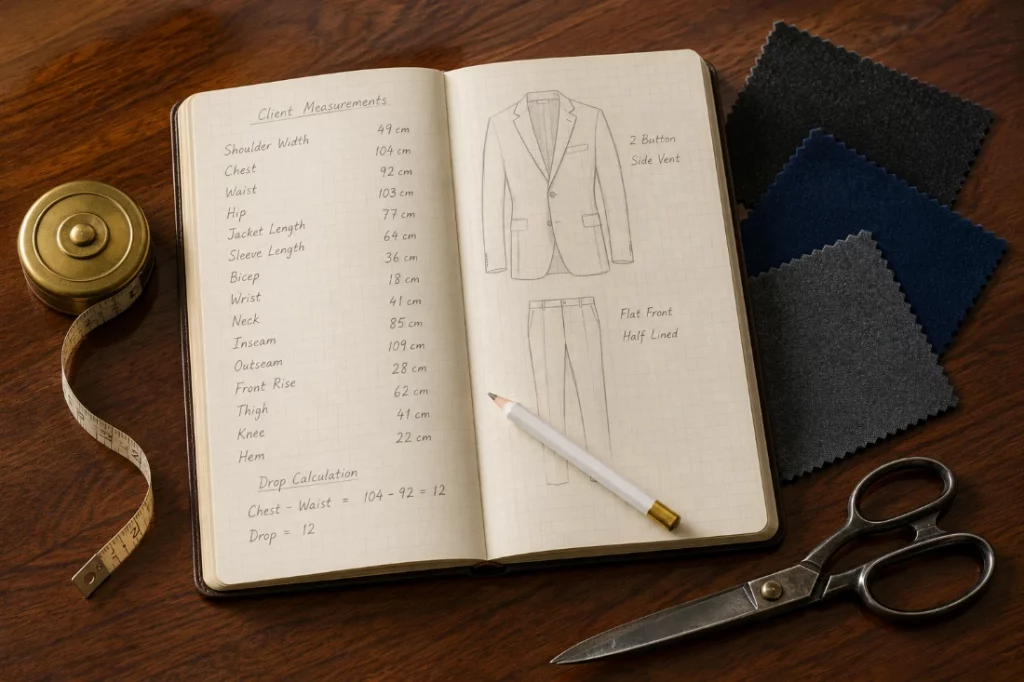
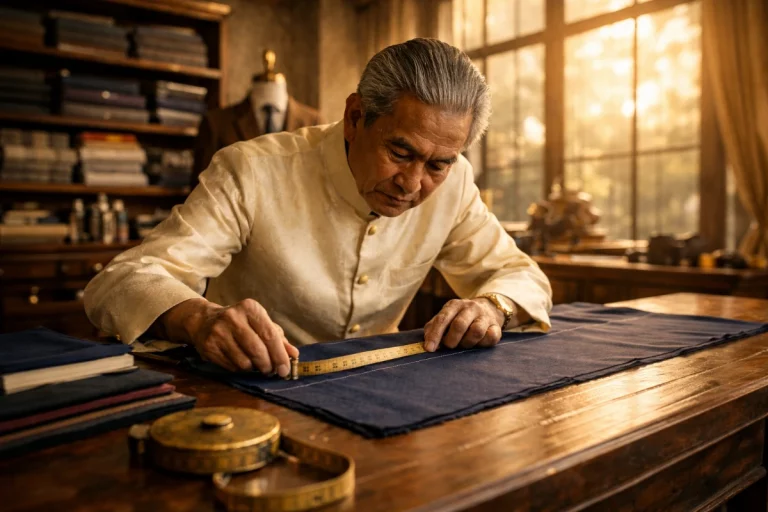
A Bangkok tailor for hard-to-fit bodies will record 20 to 30 separate measurements during your first consultation. For standard builds, many of these are corroborating data points. For hard-to-fit builds, every single measurement matters. The ones that have the greatest impact on whether your suit actually fits are:
Shoulder Width (Shoulder Point to Shoulder Point)
The single most important measurement for any suit. Shoulder width cannot be meaningfully altered after the suit is constructed, so a tailor who gets this wrong has produced a suit that will never fit correctly. For broad-shouldered builds, ask whether the tailor will measure shoulder width with the arms relaxed at the sides versus pulled forward.
Chest-to-Waist Drop
The numerical difference between your chest and waist measurements. Standard suits assume 6 inches. Athletic builds often run 8-12 inches. Plus-size builds may have negative drops (waist larger than chest). The right pattern depends on this number.
Sleeve Length (Shoulder Point to Wrist)
Standard sleeve lengths assume a torso-to-arm ratio that breaks down at heights above 6’2″ and below 5’5″. Hard-to-fit builds need sleeve length set against actual wrist position rather than a chart conversion from height.
Trouser Rise and Inseam
Rise (waist to crotch) varies more between body types than any other trouser measurement. Petite builds often need a shorter rise than off-the-rack provides; tall builds need longer. Inseam should be measured against your actual preferred trouser break with the shoes you will wear.
Jacket Length (Back Neck to Hem)
Jacket length should cover the seat fully but not extend significantly below it. For tall builds, this requires lengthening the jacket beyond standard. For petite builds, it requires shortening proportionally. The traditional rule of “thumb knuckle at jacket hem” works only for proportionally standard builds.
⚠️ Red Flags: Tailors Who Will Not Deliver on Hard-to-Fit Bodies
“We Can Fit Any Body” Without Specifics
Quality tailors talk about specific builds they have worked with and specific construction choices for different body types. Vague reassurance is a red flag. If a tailor cannot describe how they would handle your specific build, they probably have not done it before.
Fewer Than Two Fittings Offered
Hard-to-fit bodies almost always need at least two fittings, often three. A tailor who promises a one-fitting workflow for a non-standard build is producing a faster lower-quality result rather than addressing the actual fit challenges. Walk away if the tailor is not offering enough fittings for your specific situation.
No Discussion of Construction Method
Fused construction (glued canvas) cannot accommodate the structural shaping that hard-to-fit bodies need. A tailor who does not raise the question of full or half canvas construction is steering you toward a garment that will not fit correctly long term. The anatomy of a bespoke suit explains the construction differences.
Pressure Toward Express Service
24-hour or 48-hour suits are not suitable for hard-to-fit bodies regardless of how the tailor markets them. Pattern drafting and multiple fittings are non-negotiable for non-standard builds. If a tailor is pushing express service for your situation, they are prioritizing throughput over quality. Plan a minimum 5-7 day visit instead.
What to Bring to Your First Consultation
Preparation matters more for hard-to-fit clients than for standard builds. Before your first appointment with a Bangkok tailor for hard-to-fit bodies, gather the following:
- Photos of your favorite-fitting suit or jacket you already own. Include shoulder, chest, waist, sleeve, and overall silhouette. Even a poorly-fitting reference helps tailors understand what to correct.
- The actual best-fitting jacket you own, if luggage allows. Tailors can take precise measurements from existing garments that reveal what works and what does not for your build.
- Photos of celebrities or models with similar builds whose tailoring you admire. This communicates aesthetic preference more efficiently than verbal description.
- The shoes you will wear with the finished suit. Trouser break depends on shoe height; bringing the actual shoes eliminates guesswork.
- A list of specific occasions the suit needs to handle. Daily business wear, wedding, evening event, travel: the answer affects fabric, construction, and styling choices significantly.
- Honest information about weight stability or anticipated changes. Plus-size and athletic clients may have weight goals that affect how the suit should be constructed for future alterations.
For broader first-time guidance, the first-timer’s guide to buying a suit in Bangkok covers the consultation process from arrival through pickup. The Bangkok tailoring trip planner covers fitting cycle scheduling specifically.
Frequently Asked Questions: Bangkok Tailor for Hard-to-Fit Bodies
Practical answers for non-standard builds visiting Bangkok bespoke tailors
Pricing does not increase materially for hard-to-fit bodies at quality bespoke tailors. The same construction methods that handle standard builds work for non-standard builds; the differences are in pattern drafting and fitting count, both included in the base price.
Expect $400 to $1,200 for premium-tier bespoke and $800 to $2,500 for luxury-tier. The full price breakdown is in the Bangkok tailor price guide.
If a tailor charges a “complex fit surcharge” without specifics, that is usually a red flag rather than a fair pricing adjustment.
Minimum 5-7 days for a single suit. Bangkok tailors can complete standard builds in 3-4 days with rushed fittings, but hard-to-fit bodies typically need 2-3 fittings spaced at least 24 hours apart, plus construction time between fittings.
For multi-piece orders (2-3 suits, shirts, trousers), budget 7-10 days. The longer trip pays for itself in fit accuracy.
Yes. Bangkok tailors order fabric by the meter rather than from pre-cut suit lengths, which means there is no inherent constraint on height. Tailors who serve diplomatic and executive international clients regularly cut for tall builds. The shops featured in our 30 best tailors in Bangkok guide all handle tall clients as routine business.
Confirm at consultation: ask whether the tailor will need additional fabric for your length and whether the cost is included in the base quote. Most established tailors absorb the small additional fabric cost without surcharge.
Yes, and Bangkok bespoke is often the only practical option for athletic clients who want both a slim silhouette and a properly fitted chest. Off-the-rack athletic-fit lines (often labeled “slim” or “extra slim”) usually still assume standard chest-to-waist drops and produce ill-fitting results for clients with 10+ inch drops.
Quality Bangkok tailors draft side-seam shaping specifically for athletic builds, which produces a contoured silhouette without restricting movement. Ask specifically about side-seam construction during consultation.
Most quality Bangkok bespoke tailors handle plus-size clients as part of their general practice. Specialization in plus-size specifically is rare, but the relevant question is whether the tailor has experience with builds at your specific size, which most do.
Heavier tropical wool (260g-280g) drapes more flatteringly on fuller builds than the lightweight fabrics typically used in off-the-rack plus-size suits. Quality Bangkok tailors will discuss fabric weight specifically for your build during consultation.
Not from a quality Bangkok tailor. Pattern drafting for petite builds includes proportional adjustments to lapel width, pocket size and placement, button spacing, and trouser break. A properly drafted petite suit reads as proportional rather than miniaturized.
Ask the tailor specifically about lapel width recommendations for your frame. A 5’5″ client typically suits a 2.75″ to 3″ lapel rather than the standard 3.25″ to 3.5″. If the tailor cannot give a specific recommendation, they may not have enough experience with petite builds.
Yes, if the tailor has done multiple fittings properly. The final fitting before pickup should produce a suit that requires no further adjustment. If the tailor is rushing toward pickup and you feel the fit is not quite right, request an additional fitting rather than accepting the suit.
Quality bespoke tailors will not push back on this request. A tailor who pressures you to accept an imperfect fit is signaling that they would rather close the transaction than deliver the result you paid for.
Yes, this is one of the biggest advantages of buying bespoke in Bangkok. Once a tailor has drafted your pattern and you have confirmed the fit is correct, they store your measurements and pattern indefinitely. Reordering becomes a matter of fabric selection and shipping.
For hard-to-fit clients, this is particularly valuable: getting the initial pattern right is the hard part, and once it is right, you can rebuild your wardrobe from anywhere in the world. International shipping typically runs $50-150 per garment.
Find a Tailor Who Handles Your Build
The shops in our 30 best tailors directory all serve international clients with diverse body types. Pattern drafting from scratch is the difference between a suit that almost fits and a suit that fits perfectly.
Explore the 30 Best Tailors in Bangkok →A Bangkok tailor for hard-to-fit bodies is one of the few practical solutions for clients who have given up on off-the-rack tailoring entirely. The combination of pattern drafting, multiple fittings, and decades of experience with international body types means that the answer to “can a Bangkok tailor make this fit?” is almost always yes for builds that off-the-rack cannot handle. For maintaining your finished suit in Bangkok’s climate, the Bangkok suit care guide covers storage and routine maintenance.
For deeper context on the construction quality that makes hard-to-fit work possible, the anatomy of a bespoke suit covers canvas, lining, and panel construction. The how should a suit fit guide covers the universal fit principles that determine whether a suit looks right on any body. The best Bangkok climate fabrics guide covers tropical-weight options that work particularly well for fuller builds. According to the British Tailors Guild research on pattern-drafted versus block-pattern construction, the gap between standard suit fit and bespoke fit widens dramatically as builds move further from the average proportions used in industry blocks, which is precisely why Bangkok bespoke produces such different results for hard-to-fit clients.
Pierre Blake
Bangkok-based tailoring reviewer
I visit and commission work from bespoke tailors across Bangkok for the ranked guides on this site. Every shop is visited in person.
Read the full author profile →