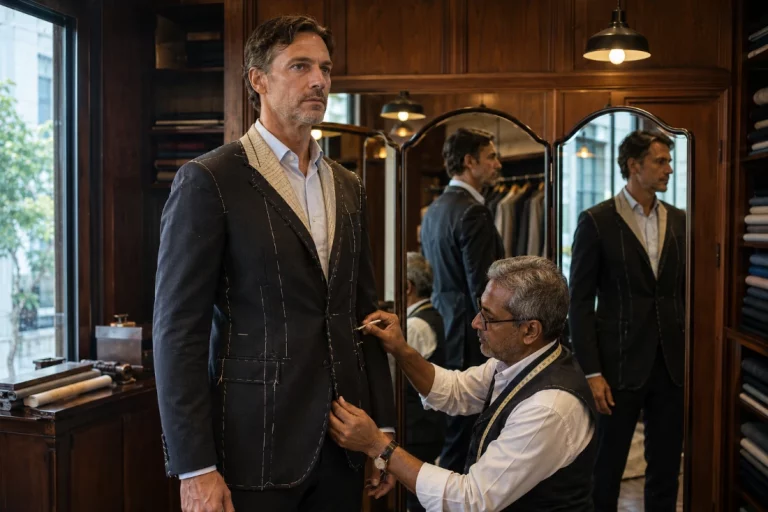
History of Bangkok Tailoring: From 1960s Diplomatic Era to Modern Bespoke
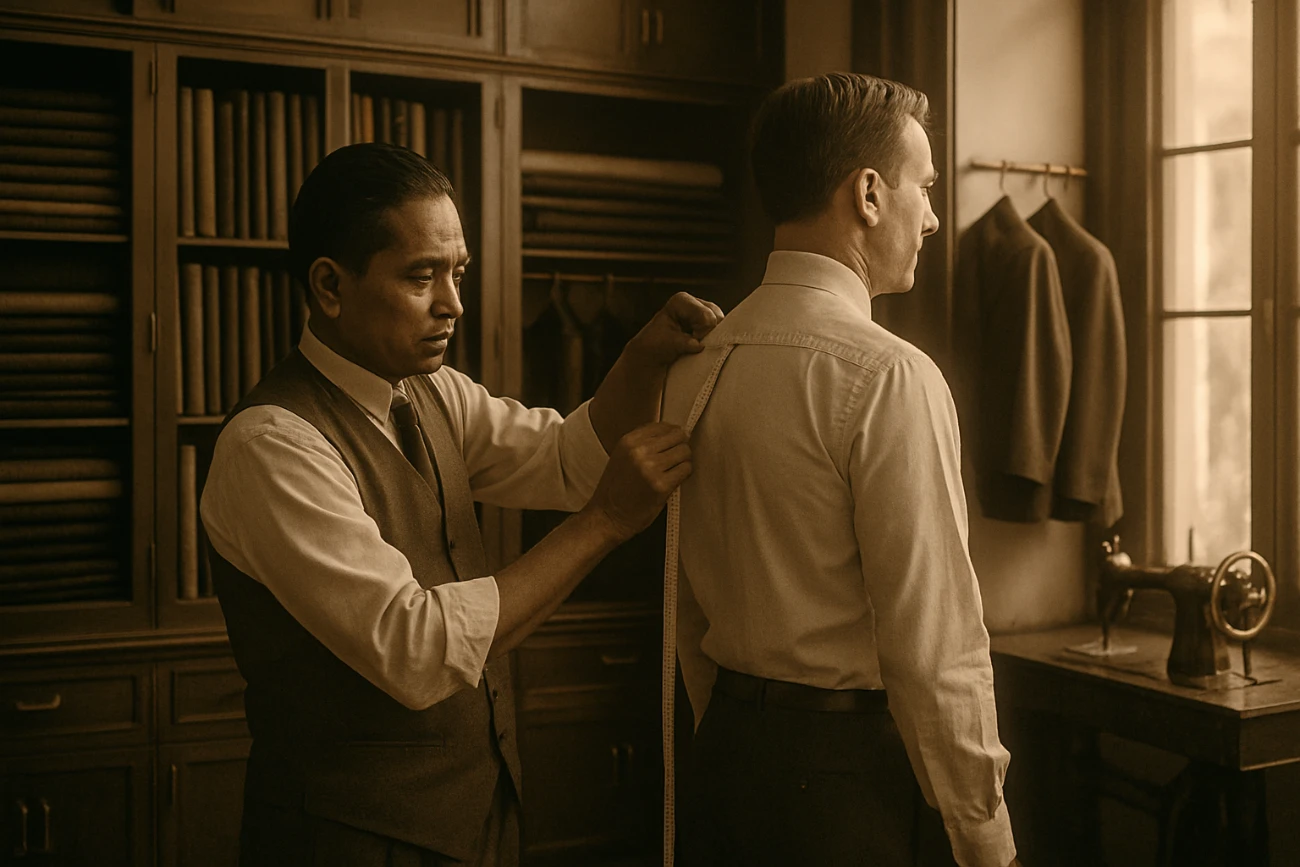
The history of Bangkok tailoring spans more than six decades, from its origins as a service industry for diplomatic and military communities in the 1960s to its current status as one of the world’s leading bespoke destinations. Understanding this history matters for anyone commissioning a Bangkok suit because the city’s tailoring traditions are not arbitrary craft preferences; they are the accumulated wisdom of generations of master tailors solving real problems for international clients in a tropical climate. This guide covers the major eras of Bangkok’s tailoring development, the master craftsmen who shaped the industry, and how Bangkok evolved from a regional curiosity into a global bespoke destination.
If you are interested in the heritage shops still operating today, this is the playbook. For the citywide picture of modern Bangkok tailoring, see the 30 best tailors in Bangkok guide. For pricing context across heritage and contemporary tiers, the Bangkok tailor price guide shows current pricing. And to understand the construction methods that define traditional Bangkok bespoke, the anatomy of a bespoke suit covers canvas, lining, and seam construction.
The history of Bangkok tailoring is the story of how a single city absorbed three distinct tailoring traditions (British, Indian, Chinese) and synthesized them into a uniquely Bangkok style that became one of the world’s leading bespoke destinations. Also, see our 30 best tailors in Bangkok rankings for the heritage and contemporary shops carrying this tradition forward.
The Origins: 1960s Diplomatic Bangkok
The history of Bangkok tailoring as we know it begins in the early 1960s, during the Vietnam War era when Bangkok became a major rest and recreation destination for American military personnel stationed throughout Southeast Asia. The American presence created consistent demand for inexpensive tailored shirts, slacks, and suits to wear during leave and at military social functions. Simultaneously, Bangkok was emerging as a regional diplomatic hub with growing embassy populations from across Europe, North America, and Asia.
Three migrant tailoring communities responded to this demand. South Asian tailors, primarily from Punjab and the broader Indian subcontinent, established shops along Sukhumvit Road and what is now Bang Rak. Chinese tailors brought generations of Hong Kong and Shanghai construction tradition. Thai tailors blended local craftsmanship with European influences absorbed through years of European missions and trading communities. The fusion of these three traditions, refined under pressure from demanding diplomatic clientele, became the foundation of modern Bangkok bespoke.
By the late 1960s, Bangkok had developed a reputation among Asian-stationed Westerners as the place to commission bespoke at prices unavailable in their home markets. American Marines on R&R returned to bases in Vietnam, the Philippines, and Okinawa wearing Bangkok-made suits. British Foreign Service officers based in Bangkok returned to London with Bangkok wardrobes. Australian businessmen working in the region built their professional wardrobes from Bangkok visits. The reputation spread by word of mouth, and the industry expanded to meet demand.
Bangkok Tailoring History at a Glance
The 1970s Expansion: From Niche to Industry
The 1970s saw the history of Bangkok tailoring transition from a niche service industry into a structured commercial sector. Tailor shops proliferated along Sukhumvit, particularly between Soi 7 and Soi 21, and along Silom and Charoen Krung. The most established families began transitioning from second-generation to third-generation operations. Sukhumvit became the contemporary commercial face of the industry while Bang Rak’s Charoen Krung corridor maintained the more traditional heritage character it carries today.
The decade also saw the first wave of Bangkok tailors investing in relationships with European mills. Italian and English fabric mills began listing Bangkok tailors in their distributor networks, which gave Bangkok shops access to mill-grade fabrics (Vitale Barberis Canonico, Holland & Sherry, Scabal) that had previously been the exclusive territory of Savile Row and Naples. This access mattered enormously: it meant a Bangkok-made suit could be constructed from the same physical fabric as a Savile Row commission, at a fraction of the labor cost.

1980s-1990s: Refinement and International Reputation
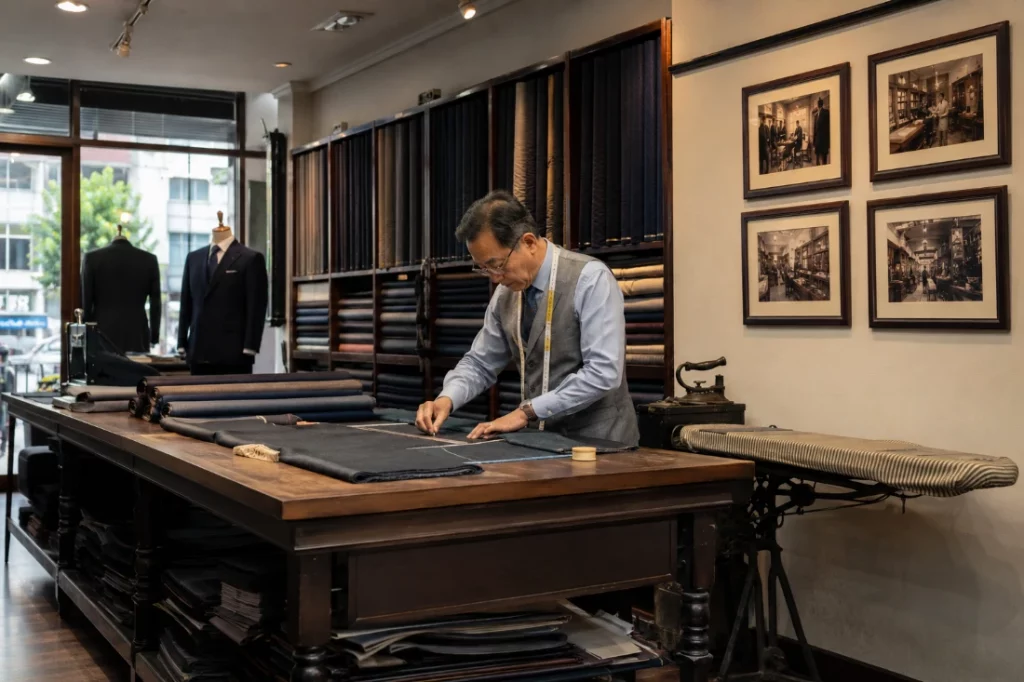
The 1980s and 1990s were the period when Bangkok tailoring’s international reputation solidified. The decade saw three concurrent developments: improving Bangkok hotel infrastructure brought higher-spending international clientele, increasingly sophisticated construction techniques as third-generation tailors took over family shops, and the emergence of specialized fabric libraries focused on tropical-weight materials suitable for both Bangkok’s climate and the international business contexts where the suits would actually be worn.
By the late 1990s, the best Bangkok tailors were serving substantial international clientele drawn from finance, diplomatic, and executive sectors. AMBFA Bespoke Tailor, which today markets diplomatic and ambassador protocol attire as a specialty, was already established in this role decades earlier. President Tailors had developed its reputation for consistent business-attire construction. The framework of contemporary Bangkok bespoke was largely in place by the millennium turn.
The Heritage Shops Still Operating Today
Bangkok tailoring history is carried forward by family-owned shops with multi-generational lineages
AMBFA Bespoke Tailor
Over 50 years of family heritage with deep roots in diplomatic and executive protocol service. AMBFA’s Sukhumvit Soi 19 location has served ambassadors, diplomats, and senior executives across decades. The shop’s longevity reflects the consistency of its construction quality and its institutional knowledge about international protocol expectations.
President Tailors
More than 50 years of tailoring expertise passed down through generations. President’s reputation rests on consistency rather than reinvention; the shop’s customers value reliable quality across multi-decade relationships rather than fashion-forward styling. The Sukhumvit 11/1 location remains active and serves both walk-in tourists and long-established executive clientele.
Bangrak Bespoke Tailor
Anchoring the heritage Charoen Krung corridor in Bang Rak district. The shop’s emphasis on traditional British and Continental construction reflects the older tailoring traditions that defined the Charoen Krung corridor before Sukhumvit emerged as the contemporary commercial center. For the broader Bang Rak context, see the best tailors in Bang Rak guide.
Multi-Generation Shops Across the City
Beyond the explicitly heritage shops, much of Bangkok’s contemporary tailoring is operated by second and third-generation family businesses that opened in the 1970s and 1980s. Many of the shops in our 30 best tailors in Bangkok guide have family histories spanning 30+ years, even if they are not explicitly positioned as heritage shops in their marketing.
The Modern Era: 2000s to Present
The history of Bangkok tailoring entered its current phase in the early 2000s when three forces transformed the industry: international travelers became more discerning and demanding, the internet enabled remote reorder workflows and global reputation building, and a new generation of Bangkok tailors began emphasizing premium-tier construction over the value-tier mass market that had defined the 1970s-1990s.
The contemporary Bangkok scene reflects this evolution. Shops like Signature’s Collection, Sam Cerruti, and Empire Tailors operate in a premium-tier space that did not really exist in 1990s Bangkok. They compete with Western bespoke houses on quality terms rather than competing with each other on price. Unique Tailor’s positioning around contemporary slim and athletic fits reflects modern aesthetic preferences. Galaxy Tailor’s express service capability reflects the time-pressed traveler economy. The current scene has greater diversity than at any prior point in the history of Bangkok tailoring.
What has not changed is the foundation: Bangkok still offers genuine bespoke pattern-drafted construction at a fraction of Western pricing, with the same fabric mill access and increasingly comparable construction techniques. The history of Bangkok tailoring is the history of this single value proposition being refined, scaled, and segmented across price tiers, while maintaining the core promise that drew international clients to Sukhumvit in 1965.
Frequently Asked Questions: History of Bangkok Tailoring
Understanding the heritage that shaped today’s Bangkok bespoke scene
The history of Bangkok tailoring as an internationally recognized destination begins in the early 1960s, driven by the Vietnam War-era American military presence and the city’s growing diplomatic community. By the late 1960s, Bangkok had developed a regional reputation; by the 1980s, the reputation had spread to North America and Europe; by the 2000s, Bangkok was considered one of the world’s top bespoke destinations alongside Hong Kong, Naples, and London.
Three migrant tailoring communities established the foundation:
- South Asian tradition: Punjabi and broader Indian subcontinent tailors brought formal construction techniques refined under British colonial rule and exposure to European mill fabrics
- Chinese tradition: Hong Kong and Shanghai tailoring lineages brought precise pattern-drafting techniques and structured shoulder construction
- Thai tradition: Local craftsmen blended local fabric expertise with European influences absorbed through diplomatic and trading communities
The fusion of these traditions, refined under pressure from demanding international clientele, became the distinctive Bangkok style.
Several shops in our directory have 50+ year continuous histories. AMBFA Bespoke Tailor and President Tailors both reference over 50 years of family heritage. Bangrak Bespoke Tailor carries the heritage of the Charoen Krung corridor’s older tailoring tradition. Many other shops have 30+ year histories but are operated by second-generation owners who took over family businesses.
For full directory of established shops, see the 30 best tailors in Bangkok guide.
Sukhumvit became the commercial center of Bangkok tailoring through a combination of factors: it was the corridor connecting downtown Bangkok to the eastern suburbs where many American military and diplomatic personnel lived, it benefited from major hotel construction in the 1960s-1980s that brought international clientele to the area, and the BTS Skytrain (opened 1999) reinforced Sukhumvit’s centrality to international visitor mobility.
Bang Rak’s Charoen Krung corridor remained the heritage center of older tailoring traditions, while Sukhumvit emerged as the contemporary commercial face. Both corridors continue to operate today with distinct characters.
The history of Bangkok tailoring includes a noticeable quality evolution. The 1960s-1970s era prioritized affordable, accessible tailoring for the mass military and tourist market, with quality varying widely between shops. The 1980s-1990s saw the emergence of established premium-tier shops alongside the continued value-tier mass market. The 2000s-2020s have seen further premium-tier development, with shops now offering construction quality genuinely comparable to Western bespoke houses.
The mass-market value tier still exists in Bangkok and accounts for a significant share of total commissions. The premium and luxury tiers are where Bangkok now competes globally on quality terms.
Several construction characteristics are distinctively Bangkok, reflecting the fusion of South Asian, Chinese, and Thai traditions with European mill fabric:
- Tropical-weight construction: Bangkok tailors developed expertise in handling 220-260g fabrics decades before this became a global focus
- Climate-aware lining: traditional Bangkok bespoke uses lighter, more breathable linings than European bespoke standards
- Hybrid canvas approaches: some Bangkok shops use partial-canvas construction that combines full-canvas chest with lighter back panels for climate adaptation
- English fluency as universal standard: Bangkok bespoke evolved with English as the working language for international clients, which shaped consultation styles
At the premium and luxury tiers, Bangkok bespoke is comparable to Savile Row on construction quality, fabric access, and fitting precision. The price difference is roughly 4:1 to 8:1 in Bangkok’s favor depending on tier comparison. What Savile Row offers that Bangkok generally does not: the longer fitting cycle (Savile Row commissions typically span 6-12 months across multiple in-person visits, allowing for more nuanced pattern refinement) and the brand prestige associated with specific Savile Row houses.
For construction quality alone, premium-tier Bangkok bespoke is at parity. For the full Savile Row experience, including brand prestige and extended fitting refinement, the difference remains real even if smaller than commonly believed.
The history of Bangkok tailoring suggests continued evolution toward higher quality tiers. Several macro trends support this: rising Thai labor costs are forcing value-tier shops to either move upmarket or face shrinking margins; international clients are increasingly willing to pay premium-tier pricing in Bangkok for quality that competes with Western bespoke; and the third generation of family-owned shops is investing in fabric mill relationships, hand-finishing techniques, and digital pattern systems that further differentiate quality from price.
The mass-market value tier will persist (driven by tourist demand) but the leading edge of Bangkok bespoke will continue moving toward premium and luxury territory.
Experience Six Decades of Bangkok Bespoke Heritage
From 1960s diplomatic-era origins to modern premium bespoke, Bangkok’s tailoring history is carried forward by the shops in our verified directory.
Explore the 30 Best Tailors in Bangkok →The history of Bangkok tailoring is ultimately the history of how a tropical city in Southeast Asia developed a globally competitive bespoke industry by absorbing three tailoring traditions and refining them under decades of pressure from demanding international clientele. For visitors planning a contemporary Bangkok bespoke commission, the heritage matters because the best shops are still operated by families with multi-generational expertise. For the construction quality that defines premium Bangkok bespoke, the anatomy of a bespoke suit covers canvas, lining, and pattern construction.
For first-time visitors, the first-timer’s guide to buying a suit in Bangkok covers what to expect from consultation through pickup. For the climate-appropriate fabric tradition that Bangkok tailors helped pioneer, the best suit fabrics for Bangkok’s humid climate covers tropical wool and blend options. For the broader Asia-Pacific comparison, the Bangkok vs Hong Kong vs Vietnam tailoring guide covers regional context. According to Britannica’s historical reference on Bangkok, the city’s emergence as a Southeast Asian commercial hub in the mid-20th century is what laid the foundation for the international service industries (including tailoring) that define its modern character.
Pierre Blake
Bangkok-based tailoring reviewer
I visit and commission work from bespoke tailors across Bangkok for the ranked guides on this site. Every shop is visited in person.
Read the full author profile →