Anatomy of a Bespoke Suit: 15 Details Between Custom and Off-the-Rack
Understanding the construction details that justify the investment
Walk into any department store and you’ll find suits ranging from $200 to $2,000. Walk into a proper tailor shop and suddenly you could be looking at a bigger price tag. To the untrained eye, they might appear to be the same thing: two pieces of fabric sewn together into a jacket and trousers.
But here’s the thing—they’re not remotely the same. The anatomy of a bespoke suit reveals construction techniques, fabric choices, and finishing details that most guys never see because they’re hidden inside the garment. These invisible elements determine how the suit wears, how long it lasts, and how it makes you look.
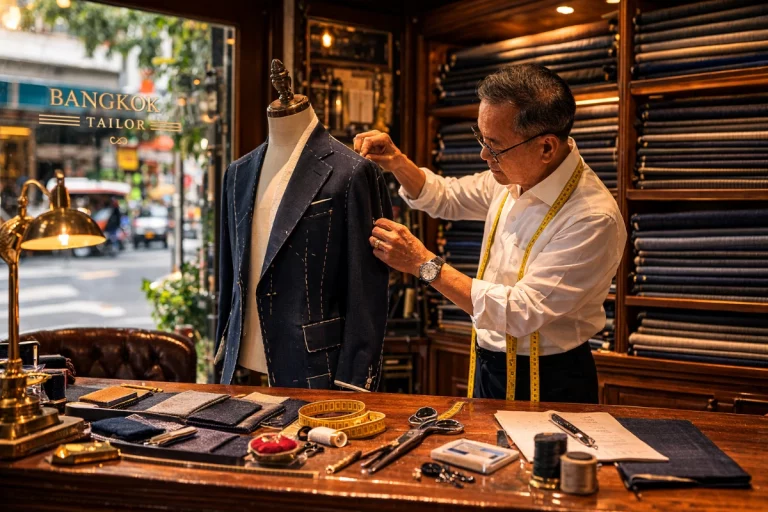
I’ve spent enough time around skilled tailors in Bangkok to understand what separates a genuinely bespoke suit from one that’s merely expensive. This guide breaks down the anatomy of a bespoke suit into fifteen specific details you can actually look for, touch, and evaluate. Some of these details you’ll see immediately. Others require turning the jacket inside out or knowing exactly where to press and feel.
Understanding the anatomy of a bespoke suit matters because it helps you know what you’re paying for when you invest in custom tailoring. More importantly, it helps you distinguish between genuine craftsmanship and expensive marketing.
- The Foundation: Canvas Construction
- The Details: Stitching and Handiwork
- The Architecture: Shoulder and Chest
- The Lapel: Roll, Break, and Gorge
- The Lining: Material and Attachment
- The Trousers: Often Overlooked, Always Important
- The Final Touch: Finishing Details
- Why This Matters: Beyond the Construction
- What to Look For When Commissioning Your First Bespoke Suit
- The Investment Perspective
- Finding the Right Tailor
- Frequently Asked Questions
The Foundation: Canvas Construction
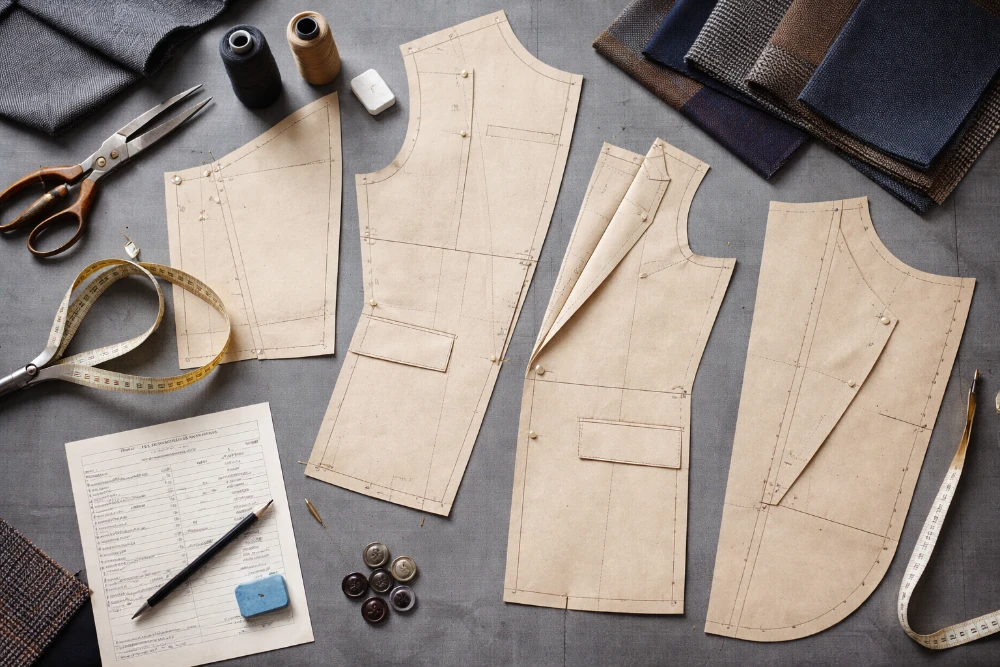
This is the single most important element in the anatomy of a bespoke suit, and it’s completely invisible when you’re wearing it. The canvas is a layer of horsehair and wool that sits between your suit’s outer fabric and inner lining.
In a genuine bespoke suit, this canvas is hand-stitched to the outer fabric using thousands of tiny stitches. It “floats” rather than being glued, allowing it to move independently. Over time, this canvas molds to your body shape, which is why a well-worn bespoke suit fits better after five years than it did on day one.
Off-the-rack suits use fused construction—they literally glue the canvas to the outer fabric using heat and adhesive. It’s faster, cheaper, and works fine until it doesn’t. That bubbling you see on cheap suits after a few dry cleanings? That’s the glue failing.
Bespoke: Floating Canvas
• Hand-stitched with thousands of tiny stitches
• Molds to body over time
• Maintains shape for decades
• Creates natural drape and roll
• Can be repaired and reshaped
Off-Rack: Fused Construction
• Glued with heat-activated adhesive
• No break-in period
• Bubbles and delaminates over time
• Stiff, flat appearance
• Unrepairable once fusing fails
Not all canvas is created equal. The anatomy of a bespoke suit includes canvas that’s specifically selected for the fabric weight and intended use of the garment.
Lightweight summer suits use lighter canvas. Heavy winter suits use substantial canvas. The best tailors match canvas weight to fabric weight, climate, and how structured you want the final garment to feel. This is the kind of detail you’ll never find in ready-made suits, where one canvas weight is used for everything.
Premium canvas contains horsehair, which has a memory—it wants to return to its original shape. Cheaper canvas might use synthetic materials that don’t have this property. Feel the difference by handling both, and you’ll immediately understand why horsehair canvas costs more.
The Details: Stitching and Handiwork
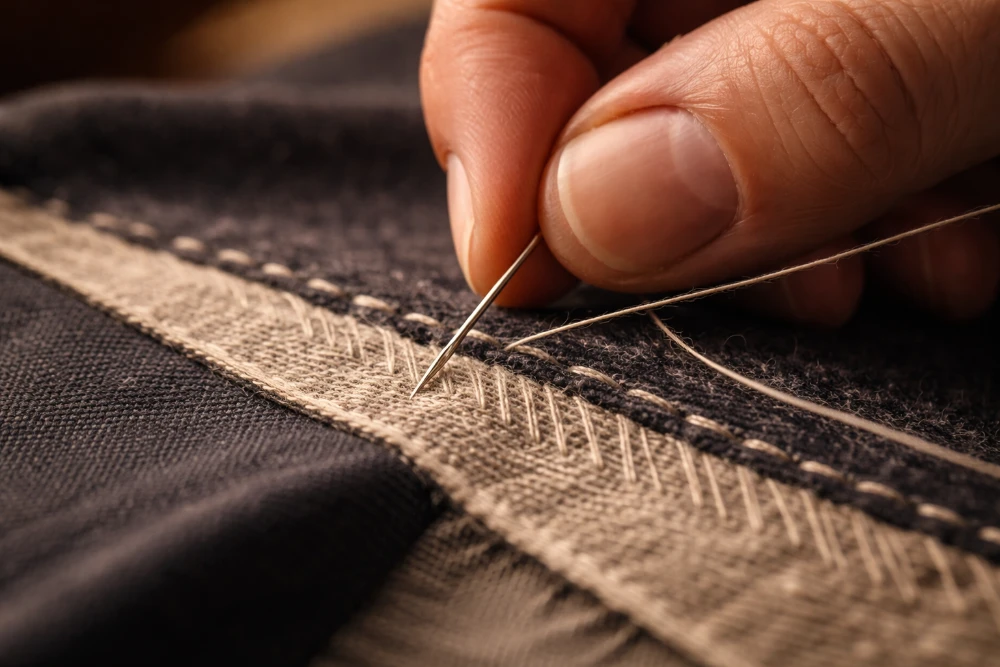
Pick stitching—those tiny, almost imperceptible stitches running along lapel edges and pockets—represents one of the most visible elements in the anatomy of a bespoke suit.
On a genuine bespoke suit, pick stitching serves a functional purpose: it attaches the canvas to the outer fabric while maintaining the fabric’s natural roll. Each stitch is placed by hand, and you’ll see slight irregularities that prove human involvement.
On factory suits, pick stitching is purely decorative. It’s added by machine after construction to mimic the look of hand tailoring. The stitches are perfectly uniform and don’t actually attach anything to anything.
Hand-sewn buttonholes separate bespoke from everything else more obviously than almost any other detail in the anatomy of a bespoke suit. A skilled tailor spends 15-20 minutes on each buttonhole, creating a structure that’s functional, beautiful, and remarkably durable.
Look for these signs of hand-sewn buttonholes:
- Slight irregularity in the stitching—no two stitches are exactly identical
- A raised, almost three-dimensional quality to the buttonhole
- Thread that perfectly matches the surrounding fabric color
- A small thread chain at each end rather than simple bar tacks
Machine buttonholes look perfect—too perfect. They’re completely uniform, flat, and often use a single thread color across all buttons regardless of fabric color.
In the anatomy of a bespoke suit, sleeves attach to the jacket body through a process called “setting” that involves hand-stitching and careful manipulation of the fabric.
A proper bespoke sleeve is sewn in by hand, allowing the tailor to ease the sleeve cap into the armhole with precision. This creates a smooth, clean line from shoulder to arm with no puckering or rippling.
The armhole itself sits higher and closer to your actual shoulder in a bespoke suit. This allows greater range of motion while maintaining a clean silhouette. Off-the-rack suits use lower armholes because they need to fit a wider range of body types, which means less mobility and more fabric bunching.
The Architecture: Shoulder and Chest
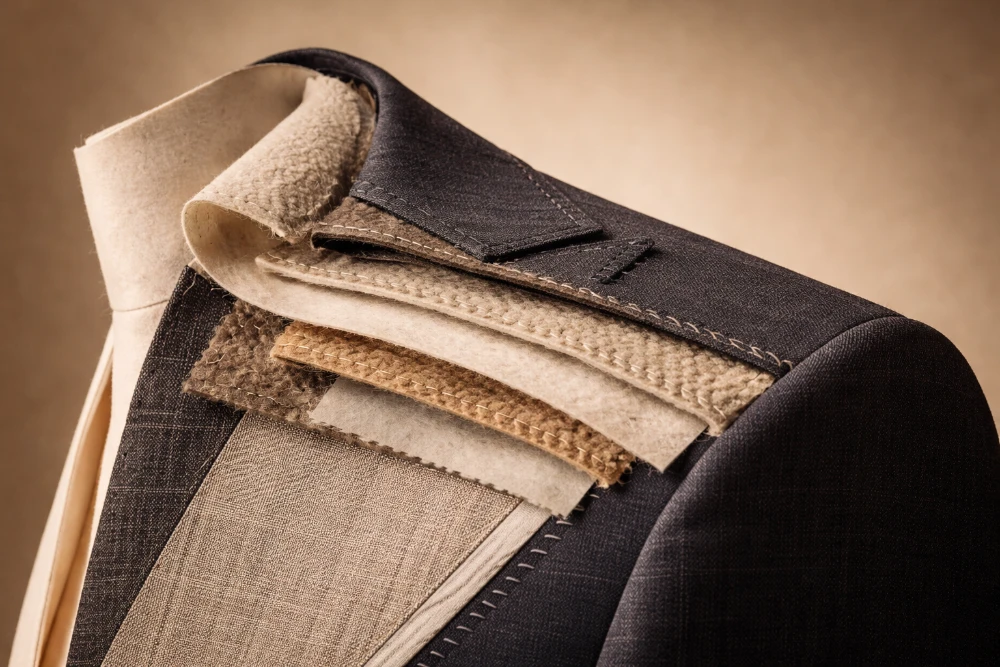
The shoulder might be the most critical element in the anatomy of a bespoke suit. It determines the entire silhouette and how the jacket hangs on your frame.
In bespoke tailoring, shoulders are built specifically for your body. The pad is hand-shaped and positioned to either enhance or minimize your natural shoulder line, depending on your preference and body type. The pad itself is made of multiple layers of wool felt and hair canvas, each layer slightly smaller than the last, creating a gradual slope rather than an abrupt edge.
Compare this to off-the-rack shoulders, which are machine-made, uniform, and designed to work for an “average” body that doesn’t actually exist. They’re either too structured (looking like football pads) or too soft (causing the jacket to collapse and wrinkle).
The chest piece—a carefully shaped piece of canvas that sits in the upper chest—is what creates that beautiful drape you see on high-end suits. This is advanced anatomy of a bespoke suit territory, where experienced tailors really separate themselves.
This canvas is cut on the bias (diagonal to the fabric grain) and hand-stitched in place with specific tension. Too tight and the jacket looks stiff. Too loose and it looks sloppy. Just right, and it creates an elegant roll from the collar down through the lapel.
Factory suits can’t replicate this. The chest piece, if it exists at all, is machine-sewn with uniform tension. It serves a structural function but creates no drape.
The Lapel: Roll, Break, and Gorge
The lapel roll—how the lapel curves away from the chest—represents one of the most visible quality indicators in the anatomy of a bespoke suit.
A proper roll happens because the canvas is hand-stitched to the outer fabric with just the right amount of ease. The lapel wants to roll naturally, creating that three-dimensional curve that catches light beautifully.
On fused suits, the lapel lies flat against the chest. It might be pressed into a curve, but it has no natural roll. It looks two-dimensional by comparison.
The gorge—where the collar meets the lapel—and the break point—where the lapel starts to roll—are proportioned specifically to your body in the anatomy of a bespoke suit.
A skilled tailor positions these elements based on your height, build, and face shape. Taller guys might get a higher gorge. Shorter guys benefit from a lower one. The break point is positioned to create the most flattering line for your torso.
Ready-made suits use standard measurements regardless of who’s wearing them. The gorge sits where it sits because that’s where the pattern puts it, not because it’s optimal for your proportions.
The Lining: Material and Attachment
Most guys never think about lining until theirs rips. But in the anatomy of a bespoke suit, lining quality matters significantly.
Bespoke suits use Bemberg or silk lining—materials that breathe, drape beautifully, and last. The lining is hand-sewn to the jacket with a technique that allows both the lining and outer fabric to move independently. This prevents that pulling and binding you feel in cheap suits.
Pay attention to how the lining attaches at the bottom of the jacket. In bespoke work, it’s tacked with loose stitches that allow the lining to hang freely. Factory suits machine-stitch the lining tightly to the bottom hem, which restricts movement and eventually causes tearing.
Turn a bespoke jacket inside out and you’ll see the true anatomy of a bespoke suit: clean, finished seams, hand-stitched inner pockets with reinforced edges, and perfectly placed internal canvas.
The inside of a bespoke jacket is nearly as beautiful as the outside. Seams are finished with hand-stitching or bound with silk tape. Pocket bags are made from strong, breathable fabric and sewn to last decades. Even the internal breast pocket is reinforced and finished properly.
Factory suits hide rough, unfinished seams behind the lining. The insides are functional but crude because nobody’s supposed to see them.
The Trousers: Often Overlooked, Always Important
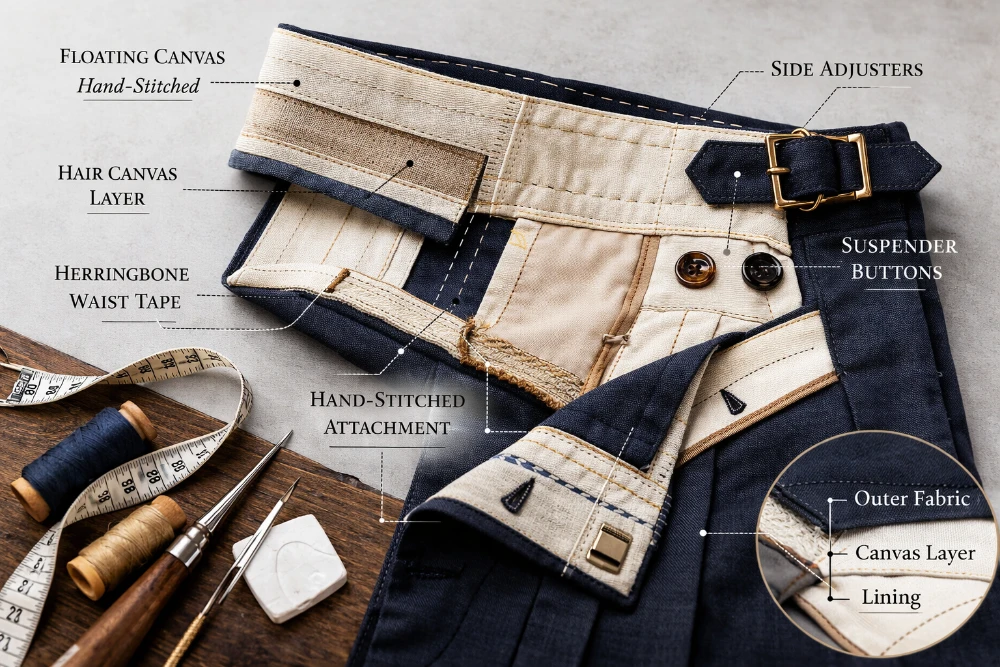
The anatomy of a bespoke suit extends to the trousers, where the waistband reveals significant construction differences.
Bespoke trouser waistbands are built with a floating canvas layer, hand-stitched to the outer fabric. This provides structure without stiffness and molds to your waist over time. The waistband is fitted specifically to your measurements, not adjusted by taking in or letting out an existing pattern.
The button and buttonhole on bespoke trousers are hand-sewn and reinforced. Side adjusters or suspender buttons are added based on your preference and attached with hand-stitching that won’t fail.
Off-the-rack trousers use a pre-formed waistband that’s machine-stitched in place. It might have interfacing, but it lacks the shaped canvas that provides proper structure and comfort.
Trouser pockets in the anatomy of a bespoke suit are built to last and function properly. The pocket bags are made from strong, usually linen-based fabric that won’t tear or wear through. They’re hand-sewn with reinforced stitching at stress points.
Watch pocket placement too. In bespoke trousers, pockets sit exactly where your hands naturally rest. The openings are slightly angled forward for easier access. Factory trousers put pockets where the pattern puts them, which often means they’re awkwardly positioned.
Bespoke trouser hems include a weight—a small chain sewn into the hem that helps trousers hang properly and maintain their break. This detail in the anatomy of a bespoke suit prevents trousers from riding up and creates that clean, uninterrupted line from waist to shoe.
The hem itself is hand-stitched with a specific technique that’s nearly invisible from the outside but incredibly secure. It can be let down or taken up multiple times over the trouser’s lifetime without damage.
Factory hems are machine-stitched, often lack weight, and can only be altered once or twice before the fabric gives out.
The Final Touch: Finishing Details
In the anatomy of a bespoke suit, even buttons receive individual attention. Genuine horn buttons are standard—they’re more durable than plastic, look richer, and they’re actually functional rather than purely decorative.
Button placement is determined by your body proportions. The top button sits where it creates the most flattering line for your torso. The spacing between buttons is calculated based on your height and build.
Factory suits use plastic buttons (even on expensive models) and position them according to standard measurements that work for nobody perfectly.
Why This Matters: Beyond the Construction
Understanding the anatomy of a bespoke suit helps you make informed decisions about where to invest your money. When you’re looking at pricing for custom tailoring, you’re not just paying for fabric and time—you’re paying for these fifteen details and dozens more.
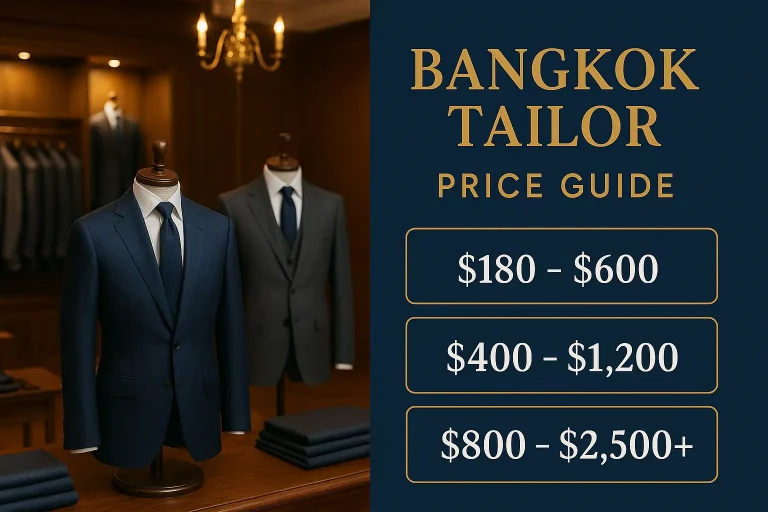
A $500 suit from a department store might look acceptable in photos. But it lacks every single element discussed in this anatomy of a bespoke suit. It won’t mold to your body. The shoulders will never fit properly. The lapels will lie flat. And after a couple of years and a few dry cleanings, it’ll look tired and cheap.
A $2,500 bespoke suit will improve with age. The canvas will shape to your body. The hand-stitching will hold. The fabric will drape better after five years than it did on day one. And when something does eventually need repair, it can be fixed because it was built to be maintained.
According to style experts at GQ, understanding these construction details helps you identify quality regardless of price point or brand name.
What to Look For When Commissioning Your First Bespoke Suit
If you’re ready to invest in your first bespoke suit, use this understanding of the anatomy of a bespoke suit to evaluate tailors and their work. When you visit potential tailors, ask to see examples of their work inside and out. First-time suit buyers should specifically ask about:
- Canvas construction: Confirm they use full floating canvas, not fused or half-canvas construction
- Hand stitching: Ask what elements are hand-sewn versus machine-sewn
- Buttonholes: Verify buttonholes are hand-sewn, not machine-made
- Fittings: Ensure you’ll have at least two fittings to perfect the fit
- Canvas options: Discuss canvas weight and quality options for your climate
- Shoulder style: Talk about shoulder construction and what will suit your body type
- Interior finishing: Ask to see the inside of completed suits to evaluate finishing quality
- Trouser construction: Confirm waistband canvas, hem weight, and pocket construction
Don’t be shy about asking questions. A confident tailor who does genuine bespoke work will happily explain every detail in the anatomy of a bespoke suit. They’re proud of their construction methods and want you to understand what makes their work special.
Tailors who get defensive or dismissive when asked about construction details probably aren’t doing true bespoke work. They might be producing made-to-measure garments (which involve some customization but use pre-existing patterns) or even just custom-fitted off-the-rack suits.
The Investment Perspective
The anatomy of a bespoke suit explains why pricing varies so dramatically in the tailoring world. When someone offers you a “bespoke” suit for $600, they’re not including most of these details. They can’t. The materials alone cost several hundred dollars, and the labor requires dozens of hours from skilled craftspeople.
Genuine bespoke suits start around $1,500 and can easily reach $5,000 or more depending on fabric choice and complexity. That’s not markup—that’s the actual cost of doing this work properly.
But here’s the thing: a well-made bespoke suit worn regularly will last 10-15 years, possibly longer. Compare that to a $500 department store suit that needs replacing every 2-3 years, and the bespoke suit becomes the more economical choice.
Finding the Right Tailor
Now that you understand the anatomy of a bespoke suit, you can evaluate tailors based on their actual work rather than their marketing. Look for tailors who:
- Show you the inside of their suits willingly
- Explain construction techniques without jargon
- Use traditional methods like hand-stitching and floating canvas
- Allow multiple fittings as standard practice
- Have examples of their work you can handle and examine
- Discuss fabric selection based on intended use, not just price
- Explain how they’ll adapt construction to your body type
The best places to find this level of craftsmanship often aren’t the most expensive or well-known. Many excellent bespoke tailors work quietly, building suits for clients who understand quality and return repeatedly over decades.
Frequently Asked Questions About the Anatomy of a Bespoke Suit
How can I tell if a suit is truly bespoke or just made-to-measure?
Check the canvas construction first. Press firmly on the chest—a bespoke suit will spring back immediately due to the floating canvas. Look at the buttonholes; bespoke buttonholes are hand-sewn with visible irregularities, while machine buttonholes are perfectly uniform. Turn the jacket inside out and examine the finishing—bespoke suits have clean, hand-finished seams and proper interior construction. Made-to-measure suits typically use fused construction, machine buttonholes, and have less refined interior finishing.
What’s the difference between half-canvas and full-canvas construction?
Full-canvas construction means the floating canvas extends from the shoulders all the way down to the bottom of the jacket, covering the entire front. Half-canvas only extends from the shoulders to roughly mid-chest, with the lower portion fused. Full canvas is superior because it allows the entire jacket to drape naturally and mold to your body. Half-canvas is a compromise—better than fully fused but not as good as full canvas. True bespoke suits always use full floating canvas construction.
How long does a bespoke suit actually last?
A well-made bespoke suit worn regularly should last 10-15 years minimum, possibly 20+ years with proper care. The floating canvas continues to mold to your body over time, actually improving the fit. The hand-stitching holds up far better than machine stitching. Compare this to off-the-rack suits that typically need replacement every 2-3 years. The key is proper maintenance: regular pressing, professional cleaning when needed (not too frequently), and proper storage.
Why are bespoke suit prices so different between tailors?
Several factors affect pricing in the anatomy of a bespoke suit: fabric quality (Super 100s vs Super 150s makes a huge difference), construction methods (all hand-stitching costs more than partial machine work), number of fittings provided, tailor’s experience and reputation, and location overhead. A $1,500 bespoke suit likely uses good fabric with mostly hand construction. A $5,000 suit uses exceptional fabric with completely hand construction and more fittings. Both can be excellent—it depends on your needs and budget.
Can I see the canvas inside the suit, or is it completely hidden?
The canvas is hidden between the outer fabric and lining, so you can’t see it directly. But you can feel it. Press on the chest area and you’ll feel the canvas layer moving independently of the outer fabric. You can also sometimes see evidence of the canvas at the jacket’s edges where the lining ends. A good tailor will happily show you canvas samples and explain how it’s constructed in your suit. Some tailors even leave a small section visible inside the pocket so you can see the hand-stitching.
Is the canvas construction method in the anatomy of a bespoke suit the same across all tailors?
The basic principle—floating canvas hand-stitched to the outer fabric—is consistent, but execution varies. Different tailors use different canvas weights, different stitching patterns, and different amounts of padding in the chest piece. Italian tailors tend toward softer construction with minimal padding. British tailors often use more structured shoulders with heavier canvas. The best approach depends on your body type, personal preference, and intended use. Discuss these options with your tailor during consultation.
How many fittings should I expect for a bespoke suit?
Genuine bespoke tailoring requires at least two fittings, often three. The first fitting happens after the pattern is created and the suit is basted together—this is when major adjustments are made to shoulder, chest, and overall fit. The second fitting comes after those adjustments, checking for final refinements. A third fitting might be needed for perfect details. Be wary of tailors who claim bespoke with only one fitting or none—that’s made-to-measure at best, not true bespoke.
What questions should I ask a tailor to verify they do true bespoke work?
Ask these specific questions: “Do you use full floating canvas or half-canvas?” (Answer should be full floating canvas). “Are buttonholes hand-sewn or machine-made?” (Should be hand-sewn). “How many fittings are included?” (Should be at least two, preferably three). “Can I see the inside of a completed suit?” (They should readily show you). “Do you cut a unique pattern for each client or adjust existing patterns?” (Should be unique pattern). If they’re evasive or can’t answer these questions clearly, they’re probably not doing true bespoke work.
Does bespoke suit construction differ for different climates?
Absolutely. The anatomy of a bespoke suit should be adapted to your climate. Hot, humid climates need lighter canvas, more breathable lining (Bemberg over silk), and less padding in shoulders and chest. Cool climates can handle heavier canvas, more structured shoulders, and richer linings. A good tailor asks about your climate and adjusts construction accordingly. This is one advantage of working with local tailors who understand regional climate needs—they know what works.
Can a bespoke suit be altered years later, or does the construction prevent modifications?
This is actually one of the major advantages in the anatomy of a bespoke suit—it can be altered substantially. The floating canvas can be reshaped, seams can be let out or taken in, shoulders can be rebuilt, and linings can be replaced. A well-made bespoke suit can be altered multiple times over its lifetime. Off-the-rack suits, especially fused ones, have very limited alteration potential because the glued layers can’t be reworked without destroying the garment. This long-term alterability is part of what justifies the investment.
What’s the best way to care for a bespoke suit to preserve its construction?
Proper care preserves all those construction details you paid for. Hang suits on proper wooden hangers with shaped shoulders—never wire hangers. Allow suits to rest at least 24 hours between wears so the canvas can recover its shape. Brush after each wear to remove dirt and dust. Dry clean only when necessary (2-3 times per year maximum)—excessive cleaning damages the canvas and fabric. Press wrinkles with steam rather than dry cleaning. Store in breathable garment bags, not plastic. Rotate between multiple suits rather than wearing the same one daily.
Conclusion: Quality You Can Feel
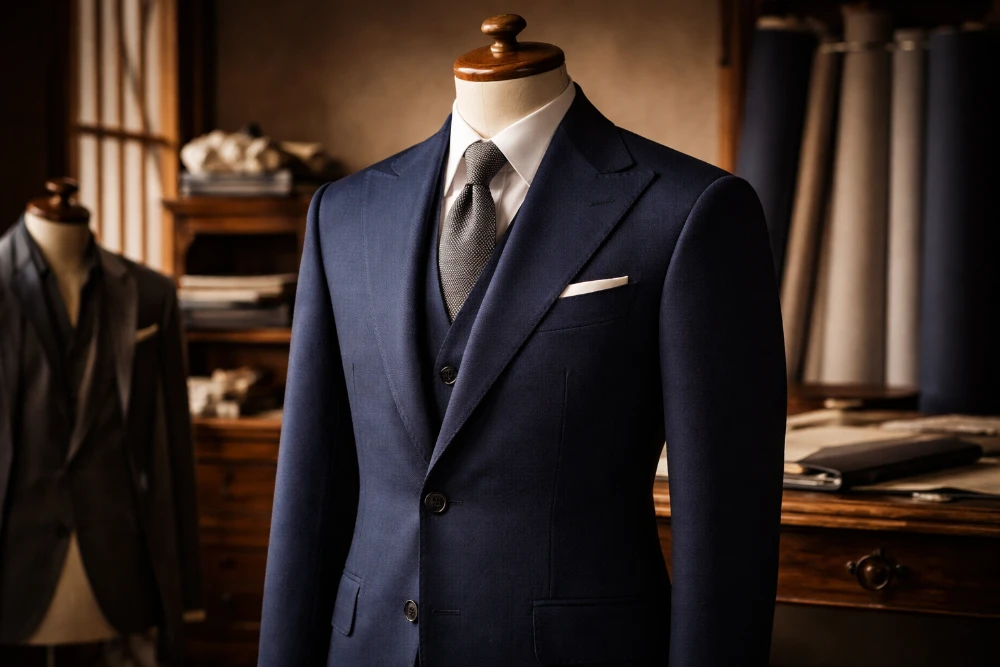
The anatomy of a bespoke suit comes down to this: genuine craftsmanship reveals itself in dozens of small details that combine to create something exceptional. Each hand-sewn stitch, each layer of shaped canvas, each carefully positioned button contributes to a garment that fits better, wears longer, and looks more distinguished than anything produced in a factory.
You don’t need to become an expert in tailoring to appreciate these differences. But understanding these fifteen details helps you recognize quality when you see it and ask the right questions when investing in custom tailoring.
The next time you’re in a tailor’s shop, ask to see the inside of a jacket. Run your fingers along the lapel. Press the chest to feel the canvas. Check the buttonholes. These elements in the anatomy of a bespoke suit tell the real story about what you’re buying.
Because at the end of the day, a suit is an investment—in your appearance, your confidence, and how you present yourself to the world. Understanding what separates genuine bespoke construction from factory-made imitations helps ensure that investment pays dividends for years to come.