Bangkok Tailor Comparison: Same Suit, 3 Price Points, Honest Results
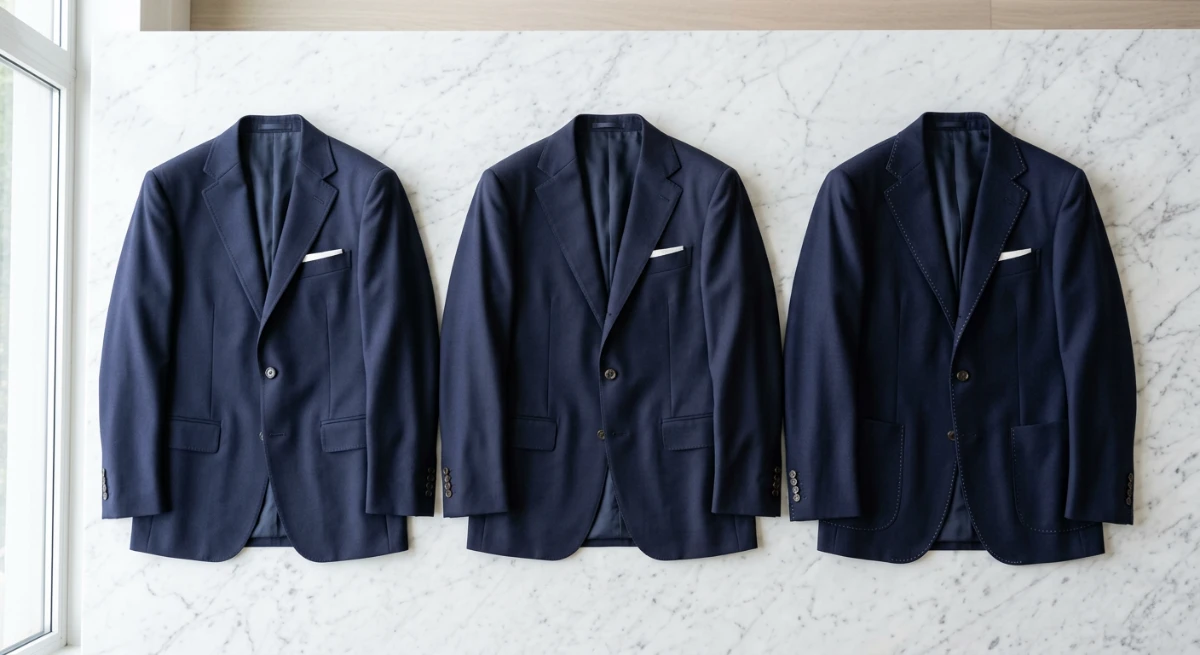
What actually happens when you order the exact same suit from three different Bangkok tailors at three different price points? We decided to find out. This Bangkok tailor comparison test is not theoretical. We commissioned a two-piece navy suit with identical specifications (notch lapel, two-button, single vent, flat-front trousers) from three shops at $200, $500, and $1,000, then documented every difference in consultation, construction, fitting, and finished product.
The results surprised us. Not because the expensive suit was better, that was expected. But because the specific ways each price tier delivers (or fails to deliver) value are rarely discussed honestly in Bangkok tailoring guides. This Bangkok tailor comparison gives you the information you need to decide where your money goes furthest.
For the full ranked list of shops we drew from, see the 30 best tailors in Bangkok guide. For a breakdown of what each price tier typically includes, the Bangkok tailor price guide covers every garment type.
The Test Parameters
To make this Bangkok tailor comparison meaningful, we controlled every variable we could. All three suits used the same design brief: a classic two-piece navy suit with notch lapels, two buttons, single rear vent, flat-front trousers with a slight break, and no cuffs. We requested the closest available fabric match at each shop (Super 110s to 120s navy worsted wool) and provided the same reference photographs.
The three price tiers represent real segments of the Bangkok market. The $200 suit came from a well-reviewed budget shop near Khao San Road. The $500 suit came from a mid-tier Sukhumvit tailor with consistent 4.5-star reviews. The $1,000 suit came from one of the top-ranked shops in our Sukhumvit guide.
We did not reveal the Bangkok tailor comparison test to any of the tailors. Each received the same brief from the same person, with the same timeline (4 days).
The Consultation Experience
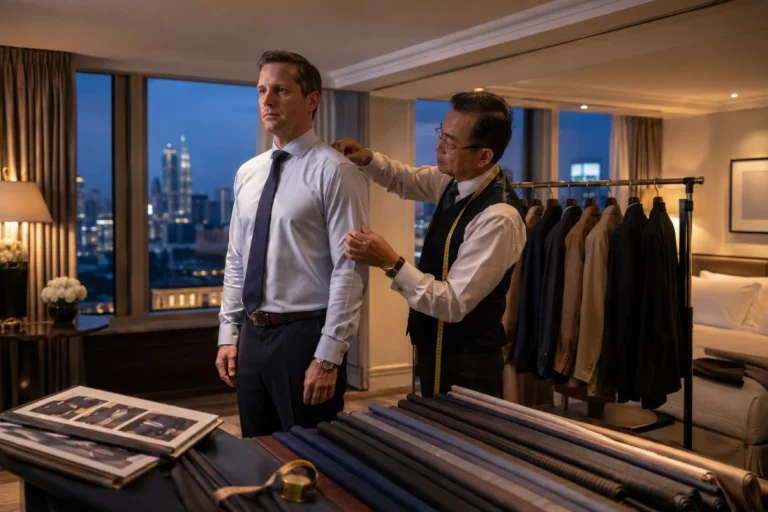
The differences began before any fabric was cut. At the $200 shop, the consultation lasted about 8 minutes. The tailor took 12 measurements, showed three bolts of navy fabric, and quoted a price within the first two minutes. No questions about lifestyle, climate, or how the suit would be worn. The deposit was taken and we were out the door.
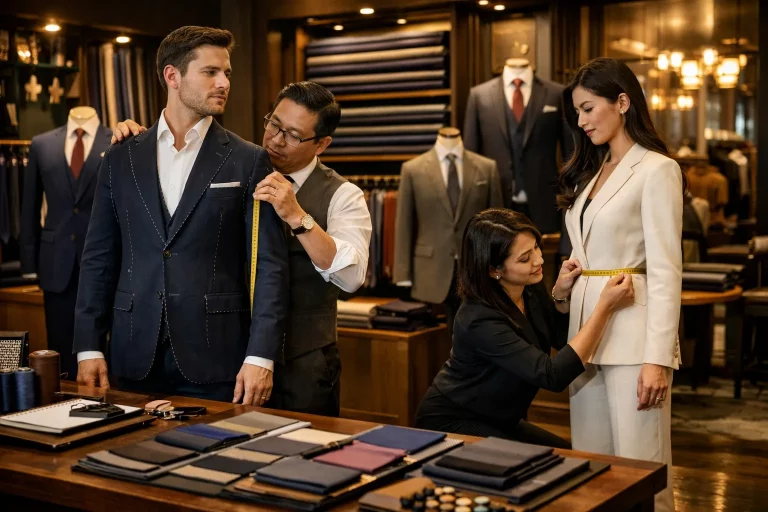
At the $500 shop, the consultation ran 25 minutes. The tailor took 18 measurements, asked where the suit would be worn, discussed lining options, and showed fabric from two different mills. He recommended against our initial fabric choice (too heavy for tropical wear) and suggested a lighter alternative. This is the kind of attentive service the master craftsmen interviews describe as the hallmark of a quality shop.
At the $1,000 shop, the consultation took 45 minutes. The head tailor took 28 measurements, observed our posture while standing and sitting, asked about body asymmetries (one shoulder slightly higher than the other), and discussed every design detail individually: lapel width relative to chest size, button stance relative to torso length, trouser rise preference, and lining weight for Bangkok humidity. He showed fabric from four Italian mills and explained the performance characteristics of each.
The pattern was clear: the consultation depth directly correlated with price. The $200 shop was selling a product. The $1,000 shop was solving a problem. If you are a first-time buyer, the first-timer’s guide explains exactly what to expect and what questions to ask during your consultation.
Construction Differences: What We Found Inside
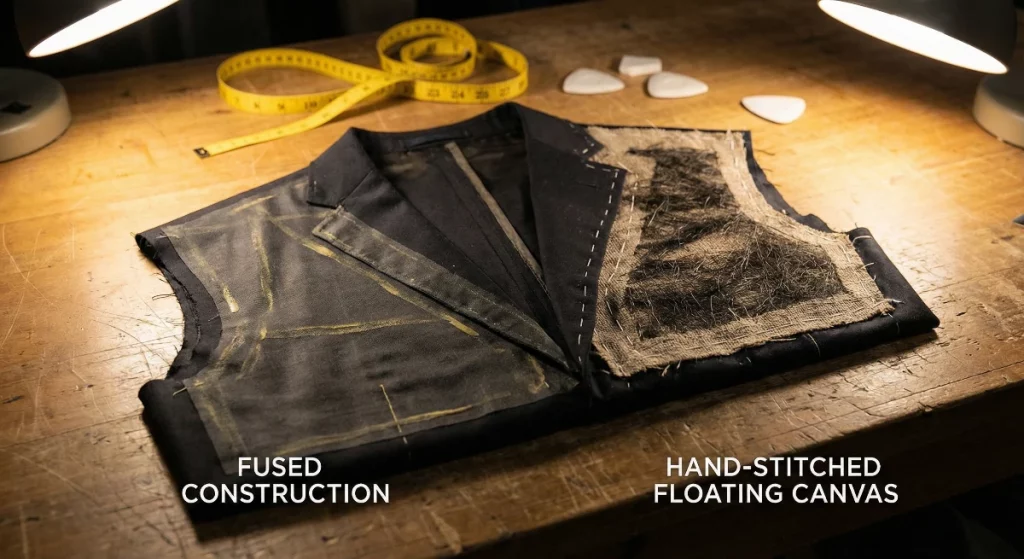
This is where the Bangkok tailor comparison became genuinely revealing. We turned each finished jacket inside out and examined the construction method, lining, stitching, and finishing.
The $200 Suit: Fused Construction
Fully fused. The canvas (interlining) was heat-bonded to the outer fabric throughout the entire jacket front. The lining was polyester, machine-stitched tightly to the hem with no independent movement. Buttonholes were machine-cut. The stitching was clean but entirely uniform, with no hand-finishing anywhere. The shoulder pads were pre-formed foam, not shaped to the body. The jacket felt stiff and slightly board-like when draped over a hand.
This is not unusual for the price point. Fused construction is standard below $300 in Bangkok. The anatomy of a bespoke suit guide explains the full spectrum of construction methods and why they matter.
The $500 Suit: Half-Canvas Construction
Half-canvas. The chest area used a floating canvas layer hand-stitched to the outer fabric, while the lower half of the jacket front was fused. The lining was Bemberg (cupro), which breathes significantly better than polyester. Buttonholes on the front were hand-sewn (visible slight irregularities), while sleeve buttonholes were machine-made. Pick stitching along the lapel edge was present but machine-applied. The shoulder pads were layered wool felt, shaped but not individually customized. According to the principles of bespoke tailoring, this half-canvas approach represents a practical compromise between full handwork and industrial production.
This represents the “sweet spot” that many Bangkok tailor comparison guides reference. You get genuine canvas construction where it matters most (the chest, which shapes the jacket’s drape) without the full cost of a completely hand-built garment.
The $1,000 Suit: Full Canvas Construction
Full floating canvas throughout the entire jacket front. Hand-stitched with thousands of tiny stitches visible when the lining was lifted. The lining was silk, slip-stitched to the jacket body so it moved independently. Every buttonhole was hand-sewn. Pick stitching along the lapels was genuine hand work. The shoulder pads were custom-shaped from multiple layers of wool felt and hair canvas, each layer progressively smaller to create a natural slope. The sleeve heads were hand-set with careful easing of the fabric.
The interior finishing was notably cleaner. Seam allowances were bound with silk tape. The chest piece canvas was visible through a small inspection window inside the breast pocket. The tailoring glossary defines every term used here if you want to review them before your own consultation.
The Fitting Process
The $200 suit had one fitting. The jacket and trousers were presented in nearly finished form. Minor adjustments were marked with chalk (sleeve length, trouser hem) and made within two hours. No structural changes were possible at this stage.
The $500 suit had two fittings. The first showed a basted jacket with temporary stitching, allowing the tailor to adjust shoulder position, chest suppression, and waist shape. The second fitting presented the nearly finished suit for final tweaks. This two-fitting minimum is what the step-by-step tailoring guide recommends as the baseline for quality work.
The $1,000 suit had three fittings over four days. The basted first fitting allowed major structural adjustments. The second fitting checked canvas placement and lining drape. The third was a formality, with only a 3mm sleeve length adjustment marked. The tailor also addressed the slight shoulder asymmetry identified during consultation, adding fractionally more padding to the left shoulder to create visual balance.
The Finished Suits: Side by Side
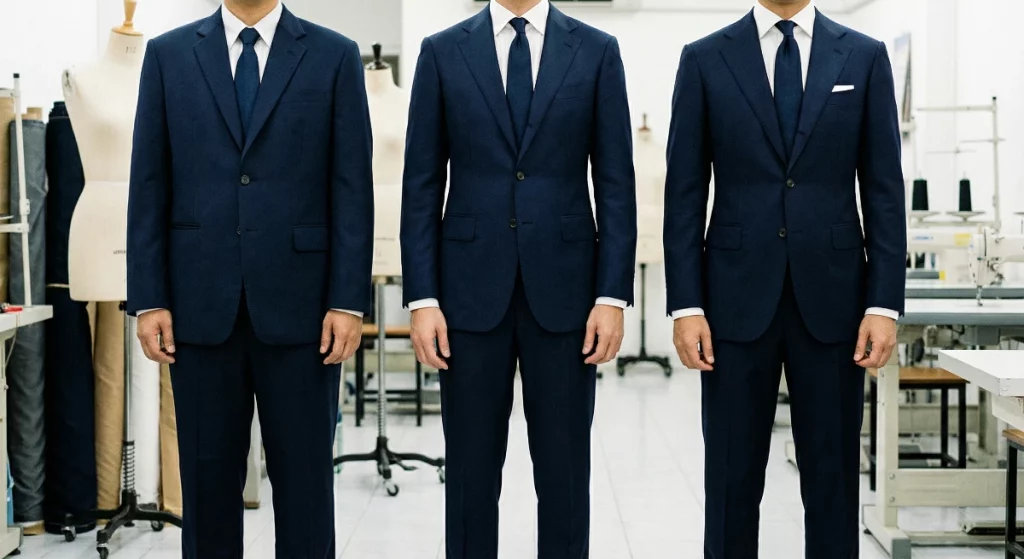
Worn back to back, the differences in this Bangkok tailor comparison were visible from across a room.
The $200 suit looked acceptable. The color was right, the proportions were reasonable, and it fit adequately. But the shoulders were slightly too wide (a common issue with pre-formed pads), the lapels lay flat against the chest with no natural roll, and the jacket had a stiff, uniform appearance that did not respond to body movement. The trousers fit but bunched slightly at the seat.
The $500 suit looked good. The lapels had a natural roll from the half-canvas chest. The shoulders fit cleanly. The fabric draped better due to the Bemberg lining allowing independent movement. The trousers fit well through the thigh and broke cleanly at the shoe.
The $1,000 suit looked exceptional. The lapels rolled three-dimensionally, catching light at different angles. The shoulders followed the body’s natural contour precisely, including the slight asymmetry. The jacket moved with the body rather than sitting on top of it. The fabric had a perceptible “life” to it, the canvas underneath allowing the wool to drape freely. The trousers fell in a clean, uninterrupted line from waist to shoe.
The Verdict: What Each Price Tier Buys You
This Bangkok tailor comparison produced a clear conclusion, but not the one most people expect. The question is not “which suit is best?” The answer to that is obvious. The question is “which suit represents the best value for how I will use it?”
The $200 suit is appropriate for someone who needs a suit for a single event (a wedding, a job interview, a funeral) and does not expect to wear it regularly for years. It will look fine in photographs and serve its purpose. It will not improve with wear, and it will likely need replacing within two to three years if worn weekly.
The $500 suit is the clear value winner for most buyers. The half-canvas construction, Bemberg lining, and two-fitting process deliver 80% of the quality of the $1,000 suit at half the price. For professionals who need a reliable rotation of business suits, this tier offers the best cost-per-wear ratio in Bangkok. It will last five to eight years with proper care and look polished throughout.
The $1,000 suit is for people who understand and appreciate the difference, and who are willing to pay for it. The full canvas construction, silk lining, three-fitting process, and individual body accommodation produce a garment that improves over years of wear. If you are building a long-term wardrobe or commissioning a statement piece for important occasions, this tier delivers genuine bespoke quality.
For a full breakdown of what each tier costs across all garment types, the Bangkok tailor price guide has current pricing. And to avoid the shops that would deliver less than what we received at the $200 level, the Bangkok tailor scams guide covers every red flag.
What We Would Do Differently
If running this Bangkok tailor comparison again, we would add a six-month follow-up to document how each suit ages. The fused $200 suit will almost certainly show bubbling at the chest within a year of regular wear. The half-canvas $500 suit should hold its shape well. And the full-canvas $1,000 suit should actually improve, molding to the body as the horsehair canvas adapts.
We would also test the same Bangkok tailor comparison with shirts. The price differential in Bangkok shirt tailoring ($30 to $150) is just as dramatic, and the custom shirts guide suggests the construction differences are equally stark.
For now, the takeaway from this Bangkok tailor comparison is straightforward: in Bangkok, you genuinely get what you pay for at each tier. The $500 range delivers extraordinary value by global standards. And the $1,000 range produces suits that would cost $3,000 to $5,000 in London or New York. Start with the 30 best tailors in Bangkok guide to find the right shop for your tier, and the best time to visit guide to plan enough days for proper fittings.
Pierre Blake
Bangkok-based tailoring reviewer
I visit and commission work from bespoke tailors across Bangkok for the ranked guides on this site. Every shop is visited in person.
Read the full author profile →