What Do the Numbers in Wool Mean? Understanding Super Numbers in Wool (100s, 120s, 150s Explained)
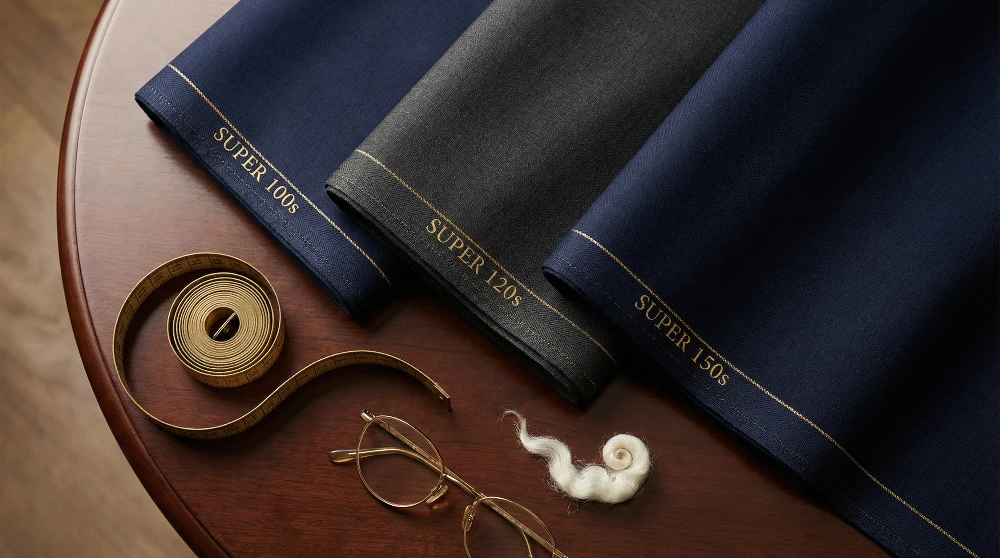
If you have ever stepped into a tailor shop, whether on Sukhumvit Road or Savile Row, and heard the phrase “Super 120s” or “Super 150s wool,” you have probably wondered: what do the numbers in wool mean? You are not alone. It is one of the most common questions clients ask when commissioning a bespoke suit in Bangkok, and the answer shapes everything from how your suit feels to how long it lasts.
This comprehensive guide decodes wool Super numbers in plain language, explains what those numbers mean for your next custom suit, and arms you with the knowledge to make confident fabric choices, whether you are investing in your first tailored suit or adding a show-stopping piece to your wardrobe. For background on how fabric choice connects to the full construction process, the Bangkok tailoring glossary defines every technical term used below.
📑 Table of Contents
- What Are Wool Super Numbers?
- The Science Behind the System
- The History of Wool Super Number Classification
- Complete Super Number to Micron Conversion Table
- Super 100s Wool Explained
- Super 120s Wool Explained
- Super 150s Wool Explained
- Super 180s and Beyond: Ultra-Luxury Wools
- Does a Higher Super Number Always Mean Better Quality?
- Durability vs. Luxury: Finding the Right Balance
- Why the Mill Matters More Than the Number
- Choosing the Right Super Number for Bangkok’s Climate
- How to Care for High Super Number Wool Suits
- Recommended Resources
- Frequently Asked Questions
1. What Are Wool Super Numbers?
When you see labels like Super 100s, Super 120s, or Super 150s on a bolt of suiting fabric, those numbers refer to a standardized grading system that classifies the fineness of the wool fiber used to weave the fabric. Understanding what do the numbers in wool mean starts with one fundamental concept: they measure fiber diameter, not thread count, not fabric weight, and not overall quality on their own.
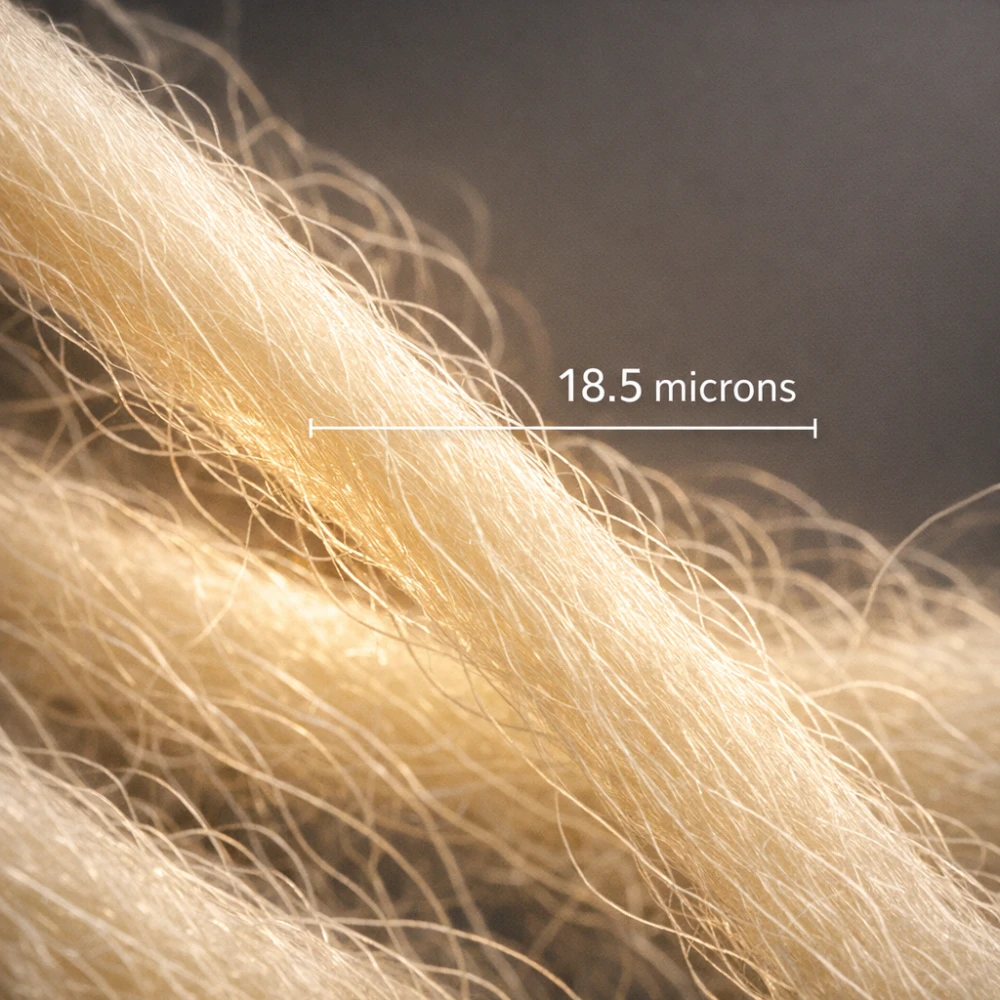
The “Super” designation is a classification of wool fiber fineness, measured in microns (micrometers). According to the International Wool Textile Organisation (IWTO), the S number correlates to a maximum fiber diameter. The higher the Super number, the finer and thinner each individual fiber is. A Super 100s wool has fibers approximately 18.5 microns in diameter, while a Super 150s uses fibers around 16 microns, nearly invisible to the naked eye, yet that seemingly tiny difference creates a dramatically different fabric.
To put that in perspective, a single human hair averages about 50 to 100 microns in diameter. The fine Merino wool used in luxury suiting typically ranges from 14 to 19.5 microns. We are talking about fibers so slender that the differences between Super grades are measured in fractions of a micron, and yet those fractions change everything about the softness, drape, sheen, and durability of your finished suit.
2. The Science Behind the System
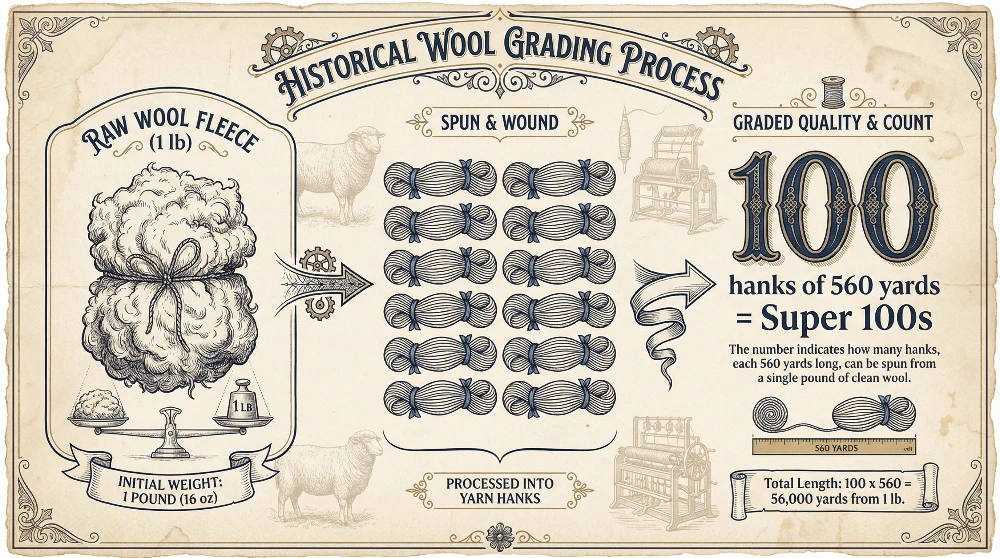
So what do the numbers in wool mean from a technical standpoint? The number itself historically corresponded to the maximum number of 560-yard hanks of yarn that could be spun from a single pound of raw wool. For example, if you could spin 100 hanks, each 560 yards long, from one pound of wool, the resulting fiber was classified as Super 100s.
Today, the system has been modernized. Rather than relying on the somewhat imprecise hank-spinning method, the IWTO defines each S number by a specific maximum fiber diameter measured in micrometers. Each step of ten on the scale (from 80s to 90s, or 100s to 110s) corresponds to exactly 0.5 micrometers less in allowed maximum fiber diameter. This gives the system scientific precision.
It is a common misconception that these numbers relate to thread count, the number of threads woven into a square inch of fabric. Thread count is relevant to cotton sheeting, not to worsted wool suiting. When clients at our recommended Sukhumvit tailors ask about Super numbers, we always clarify this distinction first. The Super number tells you about the raw material, not the construction of the finished fabric.
3. The History of Wool Super Number Classification
The story of wool Super numbers begins in Bradford, England, the historic capital of the global wool trade. In the early 20th century, cloth merchants used subjective terms like “low,” “medium,” “fine,” and “super” to describe wool quality, with “super” denoting the very finest available.
The British Wool Textile Export Corporation later introduced “Super 100s” as a formal marketing term to denote wool finer than the traditional 18.5-micron Merino standard. As the industry grew and global trade demanded consistency, the practice was refined and standardized by the IWTO to protect consumers from misleading marketing.
A landmark moment came on December 21, 1968, when the U.S. Department of Agriculture issued the United States Standards for Grades of Wool, which assigned specific ranges of average fiber diameter to each Bradford count. This brought objective measurement to what had been a subjective system. In the United States, the labeling of wool products is further regulated by the Wool Products Labeling Act of 1939, later modified by the Wool Suit Fabric Labeling Fairness and International Standards Conforming Act for products manufactured on or after January 1, 2007.
Today, the “Super” designation is governed by the IWTO Fabric Labelling Code of Practice. The word “Super” can only be used to describe fabrics made from pure new wool, or wool blended with rare fibers like mohair, cashmere, alpaca, or silk. For wool blend fabric descriptions, the word “Super” is not permitted, though the S number alone may be used if the wool content is at least 45%.
4. Complete Super Number to Micron Conversion Table
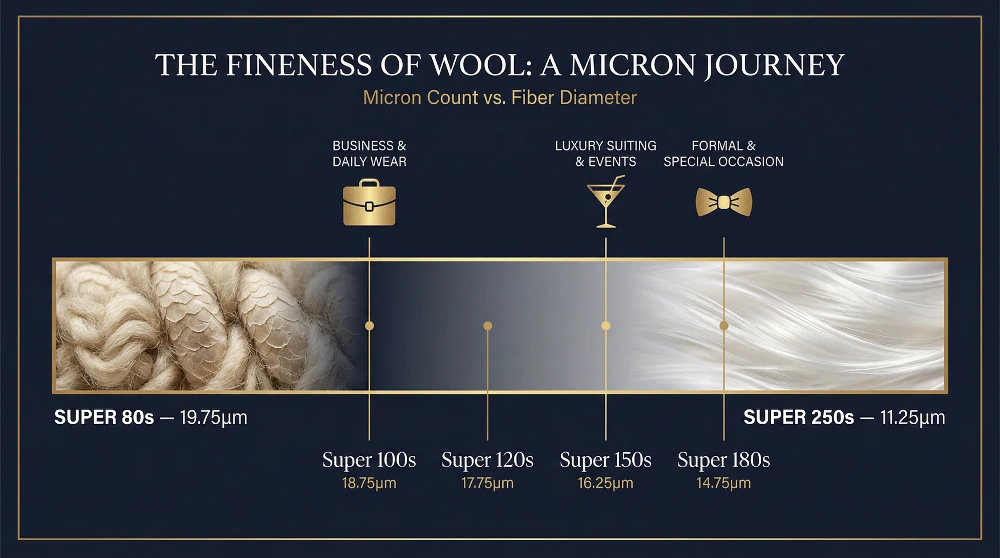
Understanding these numbers is easiest when you see the full scale laid out. Below is the complete IWTO-standardized conversion table showing each Super number and its corresponding maximum fiber diameter:
| Super Number | Maximum Fiber Diameter (Microns) | Best Use |
|---|---|---|
| Super 80s | 19.75 µm | Hardwearing everyday suits, outerwear |
| Super 90s | 19.25 µm | Durable business suits |
| Super 100s | 18.75 µm | Everyday business suits (most popular) |
| Super 110s | 18.25 µm | Business & smart casual |
| Super 120s | 17.75 µm | Versatile; business to evening wear |
| Super 130s | 17.25 µm | Refined business suits |
| Super 140s | 16.75 µm | Special occasions & executive wear |
| Super 150s | 16.25 µm | Luxury occasions, weddings, galas |
| Super 160s | 15.75 µm | High-end special occasions |
| Super 170s | 15.25 µm | Collector-grade luxury |
| Super 180s | 14.75 µm | Ultra-luxury, limited wear |
| Super 190s | 14.25 µm | Ultra-rare luxury |
| Super 200s | 13.75 µm | Museum-quality showpieces |
| Super 210s | 13.25 µm | Extremely rare collector pieces |
| Super 250s | 11.25 µm | The finest wool in existence |
Source: International Wool Textile Organisation (IWTO) Fabric Labelling Code of Practice. Each step of 10 on the S-number scale equals a 0.5-micron decrease in maximum allowed fiber diameter. Learn more at the Wikipedia S Number (Wool) article.
5. Super 100s Wool Explained

Fiber Diameter: 18.75 microns or finer
Feel: Smooth, refined, substantial
Durability: ★★★★★ Excellent
Best For: Daily business suits, travel suits, first custom suits
Super 100s wool is the workhorse of the suiting world, and for good reason. At 18.75 microns, the fibers are fine enough to produce a noticeably smooth, comfortable fabric, yet robust enough to withstand the demands of everyday wear. In practical terms, Super 100s is the perfect starting point for anyone new to custom tailoring.
A well-constructed Super 100s suit resists wrinkles, holds its shape through long workdays, and ages gracefully with proper care. It is the ideal choice for a gentleman building his first bespoke wardrobe, particularly if you are visiting one of the 30 best tailors in Bangkok for your inaugural commission. The first-timer’s guide covers how to prepare for that visit.
Many of the world’s most respected suiting mills, including Vitale Barberis Canonico, Reda, and Dugdale Bros, produce exceptional Super 100s collections that rival higher-numbered fabrics from lesser mills. If you need a suit that performs five days a week, Super 100s should be your foundation.
6. Super 120s Wool Explained
Fiber Diameter: 17.75 microns or finer
Feel: Noticeably softer, refined drape
Durability: ★★★★☆ Very Good
Best For: Business suits, client-facing roles, versatile wardrobe building
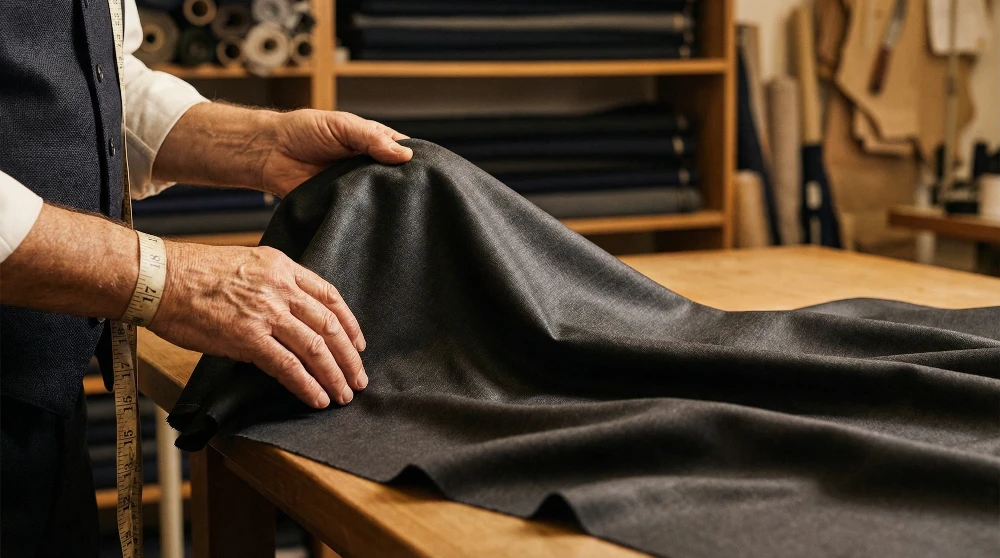
Super 120s wool strikes what many experienced tailors consider the perfect balance between comfort and durability. It is noticeably softer than Super 100s but still retains enough weight and structure to wear confidently throughout the day. For many clients who visit our recommended tailoring destinations, Super 120s represents the sweet spot.
The difference from Super 100s is immediately felt in the hand. The drape improves, a subtle natural sheen emerges, and the fabric moves more fluidly. Yet with proper care, a Super 120s suit can last years while looking refined season after season.
Super 120s is the grade we most frequently recommend for clients who want a versatile suit that transitions seamlessly from boardroom to dinner. It is durable enough for frequent wear yet luxurious enough to make a statement. If you are planning to invest in two or three bespoke suits, making at least one in Super 120s is a wise foundation strategy.
7. Super 150s Wool Explained

Fiber Diameter: 16.25 microns or finer
Feel: Exceptionally soft, silk-like smoothness
Durability: ★★★☆☆ Good (with care)
Best For: Weddings, galas, executive meetings, special events
Now we enter the realm of refined elegance. Super 150s wool is exceptionally soft, with a noticeably smoother finish. It drapes beautifully and gives that unmistakable feel of quiet luxury. But because the fibers are finer, it is slightly more delicate, not fragile, but it requires respect. This is not a suit to wear to back-to-back meetings five days a week.
The fabric has a natural luster that photographs beautifully, making it a popular choice for weddings and formal events. A Super 150s suit commissioned from a skilled Bangkok tailor, using fabric from a premier Italian or English mill, is a garment of genuine distinction. For wedding-specific options including tuxedos and formal wear, we have a dedicated guide.
In terms of investment, Super 150s represents the entry point to ultra-premium suiting. It delivers a noticeable step up in tactile luxury from Super 120s, and when tailored by an expert craftsman versed in the anatomy of a bespoke suit, the result is truly exceptional.
8. Super 180s and Beyond: Ultra-Luxury Wools
Fiber Diameter: 14.75 microns and finer
Feel: Almost silk-like, incredibly soft
Durability: ★★☆☆☆ Delicate
Best For: Black-tie events, significant celebrations, collector pieces
Super 180s and above (190s, 200s, even the rare 250s) represent the absolute pinnacle of wool refinement. These fabrics are incredibly soft, almost silk-like, and are often found in the most exclusive, limited fabric collections from elite mills like Loro Piana, Scabal, and Holland & Sherry. They are the Rolls-Royce of the suiting world.
A suit crafted from Super 200s fabric is not a daily garment. It is an investment in pure, unadulterated luxury. The delicate nature of these ultra-fine fibers means they are susceptible to wear and tear. They are not built for the rigors of frequent travel or daily office life. Instead, they are reserved for the most special occasions: a black-tie event, a landmark business deal, or a significant personal celebration.
At this extreme end of the scale, every fiber in your jacket was carefully sourced from selectively bred Merino sheep, primarily in Australia and New Zealand. The resulting fabric is so fine and rare that it commands premium prices and demands meticulous care in return. If you own a Super 180s+ suit, treat it as wearable art.
9. Does a Higher Super Number Always Mean Better Quality?
The short answer: No.
This is perhaps the most important point in understanding what do the numbers in wool mean. A higher Super number indicates a finer fiber, that is all. It does not automatically mean a “better” suit. Quality is determined by a complex interplay of fiber fineness, weave structure, fabric weight, finishing techniques, and, crucially, the skill of the tailor who constructs the garment.
A Super 120s fabric from a renowned Italian mill like Vitale Barberis Canonico will consistently outperform a poorly milled Super 150s from an unknown source. The mill’s weaving expertise, finishing processes, and quality control are equally important to the raw fiber fineness. This is why the provenance of the fabric matters as much as the number printed on its selvedge.
Furthermore, durability decreases as Super numbers increase. A Super 100s suit will outlast a Super 180s suit by years under similar wearing conditions. The finer fibers in ultra-high Super fabrics are more prone to pilling, bagging at stress points (knees, elbows, seat), and showing wear from pressing. For most men, a beautifully tailored Super 110s to Super 130s suit is the ideal balance of luxury and longevity.
10. Durability vs. Luxury: Finding the Right Balance
Once you understand what the numbers mean, the next step is aligning that knowledge with your lifestyle. Here is our recommended framework:
| Your Need | Recommended Super Range | Why |
|---|---|---|
| Daily office wear / frequent travel | Super 100s to Super 120s | Maximum durability, wrinkle resistance, easy care |
| Client meetings / professional events | Super 120s to Super 140s | Refined feel with reliable structure |
| Weddings / formal occasions | Super 140s to Super 160s | Luxurious drape and beautiful photography |
| Black-tie / once-a-year events | Super 160s to Super 200s | Ultimate softness, unmistakable luxury |
| Collector / connoisseur pieces | Super 180s to Super 250s | Rarity, exclusivity, wearable art |
The best wardrobe strategy is diversification. Keep Super 100s and Super 120s suits as the mainstay of your rotation. They are durable and resilient. Treat Super 150s+ suits as your “statement” garments, worn selectively and cared for meticulously. The Bangkok tailor price guide shows what each quality tier costs across all garment types.
11. Why the Mill Matters More Than the Number
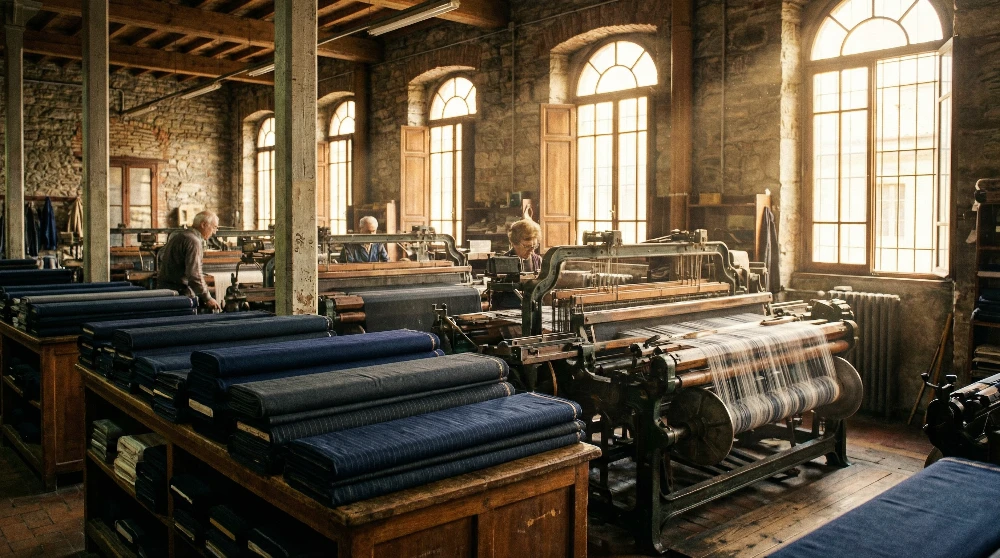
No discussion of wool Super numbers is complete without addressing the crucial role of the fabric mill. The Super number tells you about the raw fiber, but it is the mill’s craftsmanship that transforms that fiber into exceptional cloth.
World-class mills enhance wool through advanced finishing techniques including:
- High-twist yarn construction, which increases wrinkle resistance and crease recovery
- Advanced finishing, treatments that add durability without compromising hand-feel
- Blending with natural fibers, strategic additions of silk, cashmere, or mohair to enhance specific characteristics
- Precision weaving, consistent tension and density for uniform fabric performance
When selecting fabric, look for these respected mill names as indicators of genuine quality:
- Vitale Barberis Canonico (VBC), Italy’s heritage mill, known for consistent excellence
- Loro Piana, synonymous with ultra-luxury fibers
- Ermenegildo Zegna, renowned for performance-enhanced Super 150s (Trofeo line)
- Scabal, Belgian innovation with unique fabric technologies
- Holland & Sherry, British heritage with extensive luxury collections
- Dormeuil, French-British house with distinguished special editions
- Reda, excellent quality at accessible price points
- Drago, known for high-performance, high-twist wools
A skilled Bangkok tailor will source from these mills directly, ensuring authenticity. When browsing our guide to the 30 best tailors in Bangkok, pay attention to which mills each tailor partners with. It is one of the strongest indicators of quality.
12. Choosing the Right Super Number for Bangkok’s Climate

Bangkok’s tropical climate adds a unique dimension to fabric selection. With average temperatures above 30 degrees Celsius and high humidity for much of the year, fabric choice becomes even more critical than in temperate climates.
Here is our Bangkok-specific guidance:
- Fabric Weight Matters Most: In Bangkok’s heat, fabric weight (measured in grams per meter) often matters more than the Super number. Look for lightweight fabrics in the 210 to 250 g/m range regardless of Super number.
- High-Twist is Your Friend: High-twist yarns (even at Super 100s to 120s) offer excellent wrinkle recovery in humidity, crucial for Bangkok’s climate.
- Super 110s to 130s is the Sweet Spot: Fine enough to feel light and breathable, durable enough for the demands of tropical wear. This range offers the best performance-to-longevity ratio in hot, humid conditions.
- Avoid Ultra-High Supers for Daily Wear: Super 160s+ fabrics, while beautiful, will show wear faster in Bangkok’s demanding climate. Reserve these for air-conditioned events.
- Consider Wool-Silk Blends: A Super 120s wool with a silk blend can add breathability and natural sheen, perfect for Bangkok’s evenings and formal functions.
The best tailors on Sukhumvit understand these nuances intimately and will guide you toward fabrics that perform beautifully in local conditions. For seasonal timing advice, the best time to visit a Bangkok tailor guide covers when to book for best availability and attention.
13. How to Care for High Super Number Wool Suits
Once you understand the grading system, the logical next step is learning how to protect your investment. The higher the Super number, the more delicate the fabric, and the more attention it demands.
Essential Care Rules for All Wool Suits
- Rotate your suits: Never wear the same suit two days in a row. Allow at least 24 to 48 hours between wears for fibers to recover their shape.
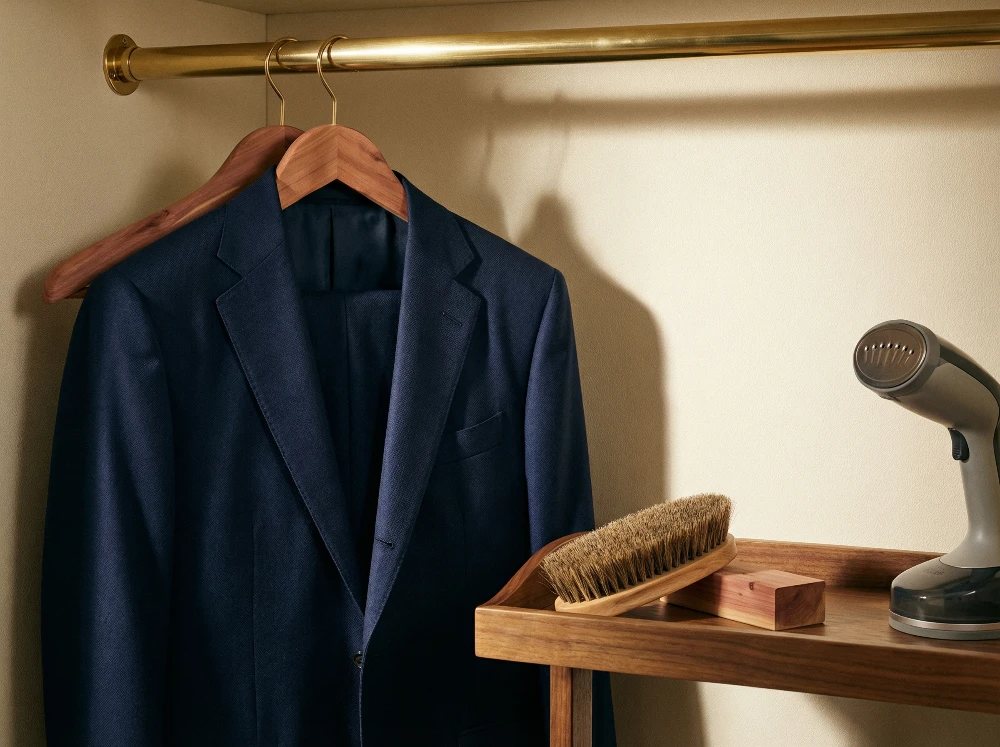
- Use quality wooden hangers: Broad-shouldered cedar hangers maintain the suit’s shape and repel moths naturally.
- Brush after every wear: A horsehair garment brush removes surface dust and restores the fabric’s nap, extending time between dry cleanings.
- Steam, do not iron: Use a garment steamer rather than a hot iron to remove wrinkles. Direct heat and pressure can damage fine wool fibers and create unwanted shine.
- Dry clean sparingly: Over-cleaning strips natural wool oils. Aim for no more than 2 to 3 dry cleanings per year for a regularly worn suit.
- Store properly: Use breathable garment bags (never plastic) and store in a cool, dry environment.
Additional Care for Super 150s and Above
- Avoid sitting for prolonged periods on rough surfaces
- Never carry heavy items in suit pockets
- Consider professional pressing rather than DIY steaming
- Store with cedar blocks to protect against moths, as ultra-fine fibers are more vulnerable
- Address any stains immediately with professional spot-cleaning
14. Recommended Resources
Understanding what do the numbers in wool mean is just one piece of the puzzle. These guides cover the rest of the journey from fabric selection to finished garment:
- The 30 Best Tailors in Bangkok, our flagship guide covering the city’s top tailoring houses with current pricing and construction details.
- The Anatomy of a Bespoke Suit, a deep dive into what separates a truly bespoke garment from made-to-measure and off-the-rack alternatives.
- Best Tailors on Sukhumvit, focused guidance for those staying in Bangkok’s most tourist-friendly district.
- Where to Get Your Suit Made, strategic advice on choosing the right district for your specific needs and budget.
- Bangkok Tailor Scams Guide, essential reading on red flags and how to protect yourself before booking any tailor.
- Custom Tailored Shirts Guide, covers collar styles, cuff options, and fabric choices for custom shirts.
15. Frequently Asked Questions
What do the numbers on a suit label mean?
The numbers (such as Super 100s, 120s, or 150s) indicate the fineness of the wool fiber used to weave the fabric. They correspond to the maximum diameter of the fiber measured in microns, as standardized by the International Wool Textile Organisation (IWTO). A higher number means a finer, softer fiber. Each step of 10 on the scale equals 0.5 microns less in maximum fiber diameter.
Is Super 150s wool better than Super 100s?
Not necessarily “better.” It is different. Super 150s is finer and softer, creating a more luxurious hand-feel and drape. However, Super 100s is more durable and wrinkle-resistant, making it better suited for everyday wear. The “best” Super number depends on how you intend to use the suit. For daily business suits, Super 100s to 120s often outperforms higher numbers in terms of longevity and practicality.
What is the best Super number for a business suit?
For most professionals, Super 110s to Super 130s offers the ideal balance of comfort, refinement, and durability. This range feels noticeably luxurious while standing up to the rigors of daily wear. If you travel frequently, a high-twist Super 120s is particularly recommended for its wrinkle resistance.
What do the numbers mean for durability?
There is an inverse relationship between Super number and durability. Lower Super numbers (80s to 120s) are more robust and resistant to wear, making them ideal for suits you will wear regularly. Higher Super numbers (150s+) produce softer, more delicate fabrics that are best reserved for occasional wear. Think of it as a spectrum from “workhorse” to “show horse.”
Does a higher Super number mean a more expensive suit?
Generally, yes. Higher Super numbers require finer wool fibers sourced from selectively bred Merino sheep, and the production process is more delicate and labor-intensive. However, the mill’s reputation and the tailor’s craftsmanship also significantly influence price. A Super 120s suit from a top mill and a skilled tailor may cost more, and perform better, than a Super 180s from a lower-quality source.
Can I wear a Super 150s suit every day?
You can, but we would not recommend it. Super 150s fabric is more delicate than everyday-grade wool and will show wear faster with daily use. You may notice pilling, knee bagging, and loss of crispness sooner than with a Super 100s to 120s suit. Super 150s is best enjoyed as a rotation piece for important meetings, events, and special occasions.
What Super number works best for Bangkok’s hot climate?
In tropical climates like Bangkok, fabric weight and weave construction matter as much as (or more than) the Super number. A lightweight (210 to 250 g/m) high-twist Super 110s to 120s will outperform a heavier Super 150s in terms of comfort and wrinkle resistance. Consult with an experienced Bangkok tailor who understands local climate demands.
Are wool Super numbers regulated or can any brand use them?
The IWTO Fabric Labelling Code of Practice governs the use of “Super” and “S” designations. Reputable mills and brands adhere to these standards. However, enforcement varies, and some lesser-known manufacturers may use Super numbers loosely. This is why purchasing from recognized mills (such as VBC, Loro Piana, Zegna, or Scabal) through trusted tailors is essential for ensuring you get what you are paying for.
What is the difference between “Super” and just the “S” number?
The word “Super” (e.g., Super 120s) can only be used for fabrics made from pure new wool or wool blended with rare natural fibers like cashmere, mohair, alpaca, or silk. The “S” number alone (e.g., 120s) may be used for wool blends, provided the wool content is at least 45%. For general wool blend descriptions, the word “Super” is not permitted under IWTO rules.
Where can I get a bespoke suit made from premium Super number wool in Bangkok?
Bangkok is one of the world’s top destinations for bespoke tailoring, offering exceptional craftsmanship at prices significantly below London or Hong Kong. Our comprehensive guide to the 30 best tailors in Bangkok covers the city’s finest establishments, many of which source directly from Italy’s and England’s premier mills. Start there to find a tailor who matches your budget, style, and fabric preferences.
Final Thoughts
Understanding what do the numbers in wool mean is about more than memorizing a micron chart. It is about making empowered decisions that align your wardrobe with your life. A suit is a deeply personal investment, and the fabric you choose is its foundation.
Here is the essential takeaway: Super numbers measure fiber fineness, not overall quality. A higher number means softer, finer fiber, but also a more delicate fabric. The best suit for you is the one that matches your lifestyle, climate, budget, and the frequency with which you will wear it. A superbly tailored Super 110s suit will always look better than a poorly fitted Super 200s.
Whether you are preparing for a destination wedding in Bangkok, building a professional wardrobe, or simply curious about what those numbers on the fabric swatch mean, we hope this guide has given you the knowledge and confidence to choose wisely. And when you are ready to commission your next suit, our 30 best tailors in Bangkok guide will point you toward the perfect tailoring experience.

Pierre Blake
Bangkok-based tailoring reviewer
I visit and commission work from bespoke tailors across Bangkok for the ranked guides on this site. Every shop is visited in person.
Read the full author profile →