Bangkok Tailoring Glossary: 100+ Essential Suit Terms
Bangkok Tailoring Glossary

Bangkok Tailoring Glossary

Master the Language of Custom Suits

From construction techniques to fabric terminology, this comprehensive guide covers 100+ essential terms every Bangkok suit customer should know. Includes Thai translations and insider knowledge.

🧵

Construction Techniques

Canvassing
Thai: แคนวาส (Canvas)
A layer of horsehair, wool, or synthetic material sewn between the outer fabric and lining of a jacket to provide structure and shape. The gold standard in suit construction.
What to ask in Bangkok: “Is this full canvas, half canvas, or fused?” Full canvas costs more but molds to your body over time.
Essential
Full Canvas
Thai: แคนวาสเต็มตัว (Canvas tem tua)
Canvas extending from shoulder to hem throughout the entire front of the jacket. The highest quality construction method that allows the jacket to drape naturally and breathe.
Expect to pay 25,000+ baht in Bangkok for full canvas construction. Worth it for suits you’ll wear frequently.
Essential
Half Canvas
Thai: ครึ่งแคนวาส (Khrueng canvas)
Canvas extending from shoulder to chest area only, with fused construction below. A quality middle-ground option that balances cost and performance.
Most Bangkok tailors offer this at 18,000-22,000 baht. Good value for business suits.
Essential
Fused Construction
Thai: ติดกาว (Tit gao – glued)
Canvas glued rather than sewn to the jacket front. Cheaper and faster but less durable. Can bubble or separate over time, especially in Bangkok’s heat.
Red flag: If a Bangkok tailor promises a suit in 24 hours, it’s almost certainly fused.
Basic
Pick Stitching
Thai: เย็บมือ (Yep mue – hand stitch)
Visible hand stitching along lapel edges and pocket flaps. A hallmark of bespoke tailoring that adds subtle detail and allows fabric to roll naturally.
Many Bangkok tailors add this by default. It’s decorative but also functional for proper lapel roll.
Advanced
Floating Canvas
Thai: แคนวาสลอย (Canvas loi)
Canvas attached only at stress points (shoulder, lapel) rather than fully glued or stitched. Allows independent movement between shell and canvas for superior drape.
True bespoke technique. Ask specifically if the tailor offers this in Bangkok.
Advanced
Basting Stitches
Thai: เย็บชั่วคราว (Yep chua khrao)
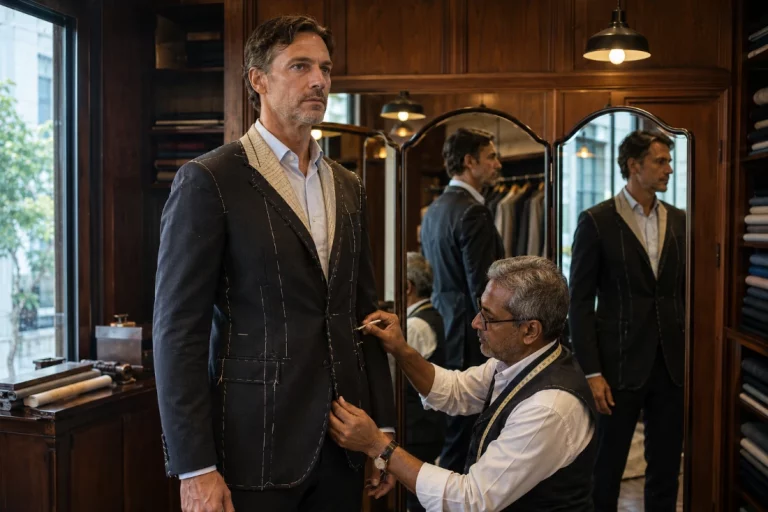
Temporary loose stitches used during fittings that are easily removed. Your Bangkok suit should have these at the first fitting so adjustments can be made.
If your first fitting has permanent stitching, the tailor is rushing. Insist on basted fittings.
Essential
Pad Stitching
Thai: เย็บแผ่นรอง (Yep phaen rong)
Hand stitching that attaches canvas to fabric at the lapel, creating the characteristic lapel roll. Done by hand in quality suits.
Check the inside of the lapel. You should see diagonal stitching patterns if done properly.
Advanced
Blind Stitch
Thai: เย็บซ่อน (Yep son)
Nearly invisible hand stitching used for hems and linings. The stitches don’t show through to the outside of the garment.
Quality indicator: check your trouser hems and jacket lining attachment for these.
Standard
Slip Stitch
Thai: เย็บลื่น (Yep leun)
Hand stitch used to attach lining to jacket, creating a “floating” effect. Allows lining to move independently from the shell.
Ask your Bangkok tailor: “Will the lining be slip-stitched?” It’s a mark of quality construction.
Advanced
📏

Fit & Measurements

Drop
Thai: ส่วนต่างอกเอว (Suan tang ok eo)
The difference in inches between chest and waist measurements. A 6-inch drop is standard, but Bangkok tailors can accommodate any proportion.
Athletic builds: May need 8-10 inch drop. Tell your tailor your actual measurements.
Essential
Suppression
Thai: เข้ารูป (Khao rup)
The degree to which a jacket is shaped at the waist. More suppression creates a more fitted, hourglass silhouette.
Bangkok tailors often default to more suppression than Western tailors. Specify if you want a looser fit.
Standard
Break
Thai: จีบขาสูท (Jeep kha suit)
The fold or crease where trouser fabric rests on shoes. Options include no break, quarter break, half break, and full break.
Modern trend: No break or slight break. Full break looks dated. Show your tailor a photo.
Essential
Pitch
Thai: มุมไหล่ (Mum lai)
The angle at which the sleeve is set into the shoulder. Affects how the arm hangs and moves naturally.
A good Bangkok tailor observes whether you have forward-leaning shoulders and adjusts pitch accordingly.
Advanced
Balance
Thai: สมดุล (Samdun)
How the jacket hangs on the body from front to back. Proper balance prevents pulling or wrinkling.
If the back hem rides up or collar gaps at neck, the balance is off. Point this out at fittings.
Essential
Ease
Thai: ที่ว่าง (Thee wang – space)
Extra fabric beyond body measurements allowing for movement and comfort. Bangkok’s heat requires more ease than temperate climates.
A suit that fits perfectly standing should have ease for sitting, reaching, breathing. Test mobility during fittings.
Essential
Divot
Thai: จุดโค้งแขน (Jut khong khaen)
The slight indentation where sleeve meets shoulder. A sign that the sleeve is properly set without excess fabric.
Look for this in the mirror during Bangkok fittings. No divot often means the shoulder is too wide.
Advanced
Rise
Thai: ความสูงเอวกางเกง (Khwam sung eo kangkeng)
Distance from crotch seam to top of waistband. Higher rise is more comfortable and traditional; lower rise is modern but less forgiving.
Bangkok trend leans toward higher rise (11-12 inches). Specify if you prefer low rise (9-10 inches).
Essential
Chest Allowance
Thai: เผื่อหน้าอก (Phuea na ok)
Extra room at chest measurement, typically 3-4 inches. Allows for breathing and layering.
In Bangkok’s heat, some prefer 4-5 inches for comfort. Discuss your lifestyle with the tailor.
Standard
Shoulder Slope
Thai: ความลาดไหล่ (Khwam lat lai)
The angle of your natural shoulder line. Some people have more slope (downward angle) than others.
A skilled Bangkok tailor measures this and cuts the shoulder pad accordingly. Prevents divots or bunching.
Advanced
🧶

Fabric & Materials

Super Numbers
Thai: ซุปเปอร์นัมเบอร์ (Super number)
Wool fineness rating. Higher numbers (Super 150s vs. Super 100s) mean finer, softer wool but less durability. Super 120s-150s is the sweet spot.
Bangkok warning: Don’t pay extra for Super 180s+. Too delicate for frequent wear and hot climates.
Essential
Worsted Wool
Thai: ขนแกะทอเรียบ (Khon kae tho riap)
Wool fabric made from long-staple fibers combed parallel, creating a smooth, fine texture. The standard for business suits.
Most Bangkok suit fabric is worsted. It’s breathable and holds shape well in humidity.
Essential
Tropical Weight
Thai: ผ้าบางเบา (Pha bang bao)
Lightweight fabric (usually 7-9 oz) designed for hot climates. Essential for Bangkok’s year-round heat.
Must-have for Bangkok: Always ask for tropical weight unless you only wear suits indoors with AC.
Bangkok Essential
Mohair Blend
Thai: ผสมขนแพะ (Phason khon phae)
Wool blended with mohair (goat hair) for added sheen, breathability, and wrinkle resistance. Popular in Bangkok for its cooling properties.
Look for 10-15% mohair content. More shine than pure wool, resists wrinkling in humidity.
Standard
Fresco Wool
Thai: ฟรีสโก้ (Fresco)
Loosely woven worsted wool with a slight texture. Highly breathable, perfect for tropical climates but wrinkles easily.
Excellent choice for Bangkok if you don’t mind a slightly rumpled look. Very comfortable in heat.
Bangkok Essential
Birdseye
Thai: ลายตาปลา (Lai ta pla – fish eye pattern)
Subtle pattern of small dots resembling birds’ eyes. Adds texture without being loud.
Great for first suit in Bangkok. More interesting than plain but still professional.
Standard
Sharkskin
Thai: ผิวฉลาม (Phiw chalam)
Smooth fabric with subtle sheen created by weaving different colored threads. Not actually shark.
Popular in Bangkok for weddings and formal events. More sheen than typical business fabric.
Standard
Linen Blend
Thai: ผสมผ้าลินิน (Phason pha linin)
Wool mixed with linen for extra breathability. Wrinkles more than pure wool but much cooler.
Consider for casual Bangkok suits or if you embrace the wrinkled aesthetic. Very comfortable.
Bangkok Option
Hopsack
Thai: ผ้าทอหยาบ (Pha tho yap)
Loosely woven fabric with a basket-weave pattern. Highly breathable and textured.
Excellent for unlined summer jackets in Bangkok. Casual business look.
Standard
Ounce Weight
Thai: น้ำหนักผ้า (Nam nak pha)
Fabric weight measured in ounces per square yard. 7-9 oz is tropical weight, 10-13 oz is mid-weight, 14+ oz is heavy winter fabric.
Bangkok rule: Never go above 10 oz unless you only wear the suit in air conditioning.
Essential
Selvage/Selvedge
Thai: ขอบผ้า (Khop pha)
The finished edge of fabric that prevents unraveling. Quality indicator showing the fabric wasn’t cut from a larger bolt.
Ask to see the selvage in Bangkok. Luxury mills often weave their name into it.
Advanced
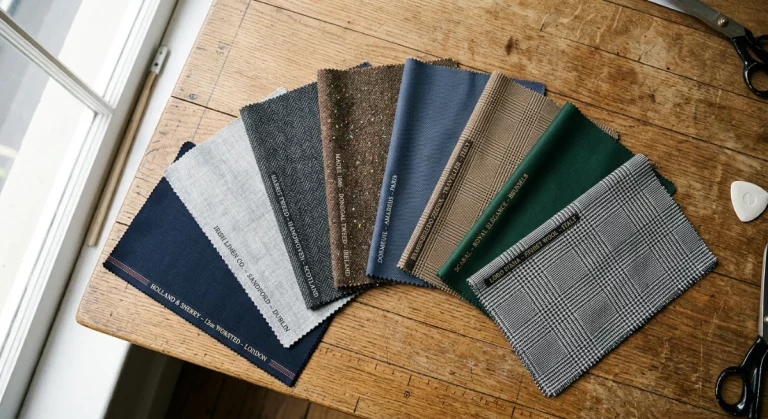
Bunch Book
Thai: สมุดตัวอย่างผ้า (Samut tua yang pha)
Sample book showing all fabric options from a mill. Bangkok tailors should have books from multiple mills.
Don’t choose fabric under fluorescent lights. Ask to see it in natural daylight.
Essential

Style Elements

Gorge
Thai: จุดแยกปกเสื้อ (Jut yaek pok suea)
The seam where the lapel meets the collar. Higher gorge creates a more modern, flattering look by elongating the torso.
Modern suits have higher gorges. Ask Bangkok tailor to show where it will sit on your chest.
Advanced
Notch Lapel
Thai: ปกติดกราน (Pok tit kran)
The most common lapel style with a triangular notch where lapel meets collar. Standard for business suits.
Safe choice for first Bangkok suit. Works for all occasions.
Essential
Peak Lapel
Thai: ปกแหลม (Pok laem – pointed collar)
Lapels that point upward toward shoulders. More formal and dramatic than notch lapels.
Traditional for double-breasted suits. Can work on single-breasted for bold style in Bangkok.
Standard
Shawl Lapel
Thai: ปกผ้าคลุม (Pok pha khlum)
Continuous rounded collar without notch or peak. Reserved exclusively for dinner jackets and tuxedos.
Don’t use on business suits. Bangkok tailors may suggest it but it’s formal wear only.
Formal
Lapel Width
Thai: ความกว้างปก (Khwam kwang pok)
Width of the lapel at its widest point. Should roughly match tie width. Currently 3-3.75 inches is classic.
Some Bangkok tailors default to narrow 2.5 inch lapels. This looks dated. Insist on proper proportion.
Essential
Buttonhole
Thai: รังดุม (Rang dum)
Opening for buttons. Hand-worked buttonholes are a mark of quality with visible thread work.
Check if Bangkok tailor does hand buttonholes or machine. Hand costs more but looks better.
Advanced
Boutonniere
Thai: รูดอกไม้ (Ru dok mai – flower hole)
The buttonhole on the left lapel, traditionally for wearing a flower. Often has a loop underneath to secure the stem.
Usually included by default in Bangkok. Can request to omit for cleaner look.
Standard
Vent
Thai: ผ่าหลัง (Pha lang)
Slit at the back hem of jacket. Options include center vent, side vents, or no vent (ventless).
Bangkok recommendation: Side vents are most versatile. Center vent is traditional British. No vent is Italian/formal.
Essential
Working Cuffs / Surgeon’s Cuffs
Thai: กระดุมแขนแกะได้ (Kradum khaen kae dai)
Functional sleeve buttons that actually unbutton. A hallmark of bespoke tailoring allowing sleeves to be rolled up.
Ask for this in Bangkok. It’s a detail that signals quality and makes future alterations harder (in a good way).
Advanced
Kissing Buttons
Thai: กระดุมชิด (Kradum chit)
Sleeve buttons sewn so close they touch. Purely aesthetic detail that shows attention to finishing.
Not all Bangkok tailors do this unless asked. It’s a nice touch for detail-oriented customers.
Advanced
👔

Lapels & Collars

Lapel Roll
Thai: การม้วนปก (Kan muan pok)
The smooth curve where the lapel folds back from the jacket front. Should be natural, not flat or angular.
This is where canvas and pad stitching matter. Poor construction creates a flat, lifeless roll.
Advanced
Collar Gap
Thai: ช่องว่างคอเสื้อ (Chong wang kho suea)
Space between jacket collar and shirt collar at the back of the neck. Should be minimal (quarter inch or less).
Fitting checkpoint: If you can fit more than two fingers between collar and neck, the jacket is poorly fitted.
Essential
Break Point
Thai: จุดพับปก (Jut phap pok)
The point where the lapel starts to fold back. Position affects the overall proportion of the jacket front.
Higher break points (closer to collar) create longer, more elegant lapels. Fashion forward look.
Advanced
Spread Collar
Thai: คอกว้าง (Kho kwang – wide collar)
Shirt collar with wider space between collar points. Accommodates larger tie knots like Windsor.
Popular for Bangkok custom shirts. Specify the exact spread you want in degrees (45-90 degrees).
Standard
Point Collar
Thai: คอแหลม (Kho laem – pointed collar)
Traditional collar with points close together. Most versatile shirt collar style.
Safe choice for Bangkok shirts. Works with any tie knot and jacket style.
Essential
Cutaway Collar
Thai: คอตัด (Kho tat – cut collar)
Extreme spread collar with points angled backward. Very modern and bold.
Fashion forward choice in Bangkok. Best with large tie knots or worn without tie.
Modern
Button-Down Collar
Thai: คอติดกระดุม (Kho tit kradum)
Collar points secured with buttons. Originally for polo players, now considered business casual.
Don’t wear with suits in formal Bangkok business settings. Fine for blazers and casual wear.
Casual
Band Collar
Thai: คอจีน (Kho jin – Chinese collar)
Collar that stands up without fold-over points. Also called Mandarin collar or Chinese collar.
Some Bangkok tailors specialize in these for business wear. Modern alternative to traditional collars.
Asian Style
📦

Pockets & Details

Patch Pocket
Thai: กระเป๋าติด (Krapao tit)
Pocket sewn onto the outside of the jacket. Casual and sporty look, typically on unstructured blazers.
Don’t use on business suits. Better for linen jackets and weekend wear in Bangkok.
Casual
Flap Pocket
Thai: กระเป๋ามีฝา (Krapao mee fa)
Most common jacket pocket with fabric flap covering opening. Standard for business suits.
Default choice in Bangkok. The flap can be tucked inside for cleaner look at formal events.
Essential
Jetted Pocket / Besom Pocket
Thai: กระเป๋าเรียบ (Krapao riap – smooth pocket)
Slit pocket with no flap. Most formal pocket style, standard for tuxedos but also appropriate for business suits.
Ask for this in Bangkok if you want a sleek, minimal look. Harder to construct than flap pockets.
Advanced
Ticket Pocket
Thai: กระเป๋าตั๋ว (Krapao tua)
Small pocket above the right jacket pocket. Originally for train tickets, now a stylish detail.
British touch that Bangkok tailors can add. Adds visual interest without being flashy.
Advanced
Breast Pocket
Thai: กระเป๋าหน้าอก (Krapao na ok)
Pocket on left chest for pocket square. Standard on all suit jackets.
Always included in Bangkok suits. Can request specific depth if you wear thick pocket squares.
Essential
Inside Pockets
Thai: กระเป๋าด้านใน (Krapao dan nai)
Interior pockets for wallet, phone, etc. Standard placement is left chest and sometimes right chest and lower inside pockets.
Tell your Bangkok tailor what you carry. They can add custom pockets for phone, passport, business cards.
Standard
Slanted Pockets
Thai: กระเป๋าเฉียง (Krapao chiang)
Trouser pockets cut at an angle rather than straight. Creates cleaner front line and easier access.
More flattering than straight pockets. Most Bangkok tailors do this by default for dress trousers.
Standard
Watch Pocket
Thai: กระเป๋านาฬิกา (Krapao nalika)
Small pocket inside trouser waistband, originally for pocket watches. Also called a fob pocket.
Largely decorative now. Some Bangkok tailors include it, others omit it. Your choice.
Traditional

Buttons & Closures

Horn Buttons
Thai: กระดุมเขาสัตว์ (Kradum khao sat)
Buttons made from natural animal horn, typically water buffalo. More interesting texture and color variation than plastic.
Quality upgrade in Bangkok. Real horn has unique grain patterns. Ask to see options.
Advanced
Mother of Pearl Buttons
Thai: กระดุมมุก (Kradum muk)
Buttons made from shell interior with natural iridescence. Standard for quality dress shirts.
Should be included on Bangkok custom shirts. If tailor offers plastic, go elsewhere.
Essential
Corozo Buttons
Thai: กระดุมลูกปาล์ม (Kradum luk palm)
Buttons made from palm nut. Looks like horn but more uniform. Eco-friendly alternative.
Good middle ground in Bangkok between cheap plastic and expensive horn.
Standard
Shank Button
Thai: กระดุมมีก้าน (Kradum mee kan)
Button with a loop on back instead of holes. Creates space between button and fabric for better drape.
Standard for suit jackets. Creates the proper stand-off from fabric.
Essential
Two-Button vs Three-Button
Thai: สองกระดุม vs สามกระดุม (Song kradum vs sam kradum)
Number of buttons on jacket front. Two is modern standard, three is traditional but less fashionable.
Go with two buttons in Bangkok unless you’re very tall or specifically want vintage look.
Essential
Button Stance
Thai: ตำแหน่งกระดุม (Tamnaeng kradum)
Height of buttons on jacket front. Higher stance is more modern and flattering for most builds.
Some Bangkok tailors use old patterns with low button stance. Show photos of modern stance you prefer.
Advanced
Contrast Buttons
Thai: กระดุมตัดกัน (Kradum tat kan)
Buttons in a different color than the fabric. Can be subtle (brown on navy) or bold (brass on navy).
Bangkok blazers often feature brass or gold buttons. Classic nautical look for unstructured jackets.
Style Choice
👖

Trousers & Pants

Pleats
Thai: จีบกางเกง (Jeep kangkeng)
Folds in fabric at waistband providing extra room through hips and thighs. Single pleat or double pleat are options.
Flat front is modern and slim. Pleats are traditional and more comfortable. Bangkok heat might make you prefer pleats.
Essential
Cuff / Turn-up
Thai: ขาพับ (Kha phap)
Folded hem at bottom of trousers, typically 1.5 inches. Adds visual weight and formality.
Traditional with pleated trousers, optional with flat front. Most Bangkok clients choose cuffs.
Standard
Crease
Thai: รอยพับกางเกง (Roi phap kangkeng)
Pressed vertical line running down front and back of trouser leg. Essential for dress trousers.
Bangkok humidity fights creases. Ask tailor about permanent creasing or just accept you’ll need frequent pressing.
Essential
Side Adjusters
Thai: สายรัดข้าง (Sai rat khang)
Fabric straps on trouser sides for adjusting waist fit. Eliminates need for belt.
Elegant detail for formal trousers in Bangkok. Allows minor weight fluctuations without alterations.
Advanced
Waistband Lining
Thai: ผ้าซับเอวกางเกง (Pha sap eo kangkeng)
Interior fabric lining the waistband. Can be grosgrain ribbon or silk for comfort.
Upgrade option in Bangkok. Silk lining feels luxurious and reduces perspiration transfer to outer fabric.
Advanced
Belt Loops
Thai: ห่วงเข็มขัด (Huang khem khat)
Fabric loops at waistband for holding belt. Standard is 5-7 loops spaced evenly.
Can be omitted on formal trousers with side adjusters. Bangkok tailors should position them properly to align with trouser construction.
Essential
Brace Buttons
Thai: กระดุมเอี๊ยม (Kradum iam)
Interior buttons for attaching suspenders/braces. Traditional alternative to belt.
Very elegant option for formal wear. Tell Bangkok tailor if you want this feature included.
Advanced
Inseam
Thai: ความยาวขา (Khwam yao kha)
Measurement from crotch to hem along inside leg. Critical for proper trouser length.
Bangkok tailors measure this while you’re standing. Wear the shoes you’ll wear with the suit.
Essential
Outseam
Thai: ความยาวด้านนอก (Khwam yao dan nok)
Measurement from waist to hem along outside leg. Used to determine proper rise and overall proportion.
Less commonly discussed but important for getting the proportions right, especially with high-rise trousers.
Standard
Leg Opening
Thai: ปากขา (Pak kha)
Circumference of trouser hem. Affects overall silhouette. Currently 15-17 inches is modern classic.
Skinny legs (14 inches or less) look dated. Too wide (18+ inches) looks sloppy. Bangkok tailors should measure your preference.
Essential
🇹🇭

Essential Thai Tailoring Terms

ช่างตัดเสื้อ (Chang Tat Suea)
Pronunciation: “Chang tat sua”
Tailor. Literally translates to “clothing cutter/maker.”
When asking for recommendations: “คุณรู้จักช่างตัดเสื้อที่ดีไหม?” (Do you know a good tailor?)
Thai Essential
วัดตัว (Wat Tua)
Pronunciation: “Wat tua”
Take measurements. What the tailor does at your first appointment.
The tailor might say: “มาวัดตัวครับ/ค่ะ” (Come for measurements)
Thai Essential
ลองตัว (Long Tua)
Pronunciation: “Long tua”
Try on / fitting. Your second and third appointments to check fit.
“พรุ่งนี้มาลองตัวนะครับ” means “Come tomorrow for fitting”
Thai Essential
แก้ไข (Kae Kai)
Pronunciation: “Gae kai”
Alter / fix / adjust. Use when something needs to be changed.
“ต้องแก้ไขตรงนี้” (Need to fix this area) – point to the problem spot
Thai Essential
คับ (Khap)
Pronunciation: “Kap”
Tight. Use when something is too tight.
“แขนคับไปหน่อย” (Sleeves are too tight) “เอวคับ” (Waist is tight)
Thai Essential
หลวม (Luam)
Pronunciation: “Luam”
Loose. Use when something is too big.
“หลวมเกินไป” (Too loose) “ต้องการหลวมหน่อย” (I want it a bit looser)
Thai Essential
ยาวไป (Yao Pai)
Pronunciation: “Yao pai”
Too long. Use for sleeves, pants, jacket length.
“แขนเสื้อยาวไป” (Sleeves too long) “ขากางเกงยาวไป” (Pants too long)
Thai Essential
สั้นไป (San Pai)
Pronunciation: “San pai”
Too short.
“แขนสั้นไป” (Sleeves too short) – important to catch at first fitting
Thai Essential
เข้ารูป (Khao Rup)
Pronunciation: “Khao roop”
Fitted / slim fit. Describes a suit that follows body shape closely.
“ต้องการเข้ารูป” (I want it fitted) vs “ไม่เข้ารูปมาก” (Not too fitted)
Thai Essential
ผ้า (Pha)
Pronunciation: “Paa”
Fabric / cloth. The material your suit is made from.
“ผ้าชนิดนี้เท่าไหร่?” (How much is this fabric?) “มีผ้าที่บางกว่านี้ไหม?” (Do you have thinner fabric?)
Thai Essential
เสื้อสูท (Suea Suit)
Pronunciation: “Sua suit”
Suit jacket. The top part of a suit.
“เสื้อสูทเข้ารูป” (Fitted suit jacket) “เสื้อสูทสีกรมท่า” (Navy suit jacket)
Thai Essential
กางเกงสูท (Kangkeng Suit)
Pronunciation: “Gang-geng suit”
Suit trousers / dress pants.
“กางเกงสูทยาวไป” (Suit pants too long)
Thai Essential
เชิ้ต (Shert)
Pronunciation: “Shirt” (Thai pronunciation)
Dress shirt. Custom shirts are popular in Bangkok.
“เชิ้ตสีขาว” (White shirt) “เชิ้ตแขนยาว” (Long sleeve shirt)
Thai Essential
ราคา (Rakha)
Pronunciation: “Ra-kaa”
Price. Always ask before committing.
“ราคาเท่าไหร่?” (How much?) “ราคารวมทุกอย่างใช่ไหม?” (Is that the total price?)
Thai Essential
พร้อมเมื่อไหร่ (Phrom Muea Rai)
Pronunciation: “Prom mua rai”
When will it be ready? Critical question for Bangkok tailoring.
Response might be: “อีกสามวัน” (Three more days) “อาทิตย์หน้า” (Next week)
Thai Essential
ส่งต่างประเทศได้ไหม (Song Tang Prathet Dai Mai)
Pronunciation: “Song tang pra-tet dai mai”
Can you ship internationally? For when you want suits sent home.
Most established Bangkok tailors ship worldwide. Ask about costs upfront.
Thai Useful

Quality Indicators to Check

Pattern Matching
Thai: ลายเรียง (Lai riang)
Stripes and patterns should align at seams, especially at shoulder, chest pocket, and collar. Shows attention to detail and lack of rushing.
Quality test: Check if stripes align perfectly across pocket and jacket front. If they don’t, the tailor is cutting corners.
Essential
Even Stitching
Thai: เย็บเรียบร้อย (Yep riap roi)
Consistent stitch length and tension throughout garment. No loose threads or puckering.
Check collar, lapels, sleeve attachment, and trouser hems during Bangkok fittings. Uneven stitching means rushed work.
Essential
Collar Symmetry
Thai: คอสมมาตร (Kho sam-mat)
Both sides of collar should be identical in size and shape. Should sit flat against neck without gapping or waving.
Stand in front of mirror during fitting. If collar is asymmetrical or one side won’t lay flat, it needs rework.
Essential
Sleeve Lining
Thai: ซับในแขน (Sap nai khaen)
Interior fabric lining the sleeve. Should be smooth, allow easy on/off, and not bunch when arm is extended.
Premium Bangkok suits use silk or bemberg rayon lining. Budget suits use polyester which doesn’t breathe in heat.
Standard
Shoulder Structure
Thai: โครงสร้างไหล่ (Khrong sang lai)
The padding and canvas creating shoulder shape. Should look natural, not angular or collapsed.
Check from behind in Bangkok fitting. Shoulders shouldn’t droop or stick out past your natural shoulder line.
Essential
Lining Quality
Thai: คุณภาพซับใน (Khun-naphap sap nai)
Interior fabric quality and construction. Full lining vs half lining vs unlined affects durability and comfort.
For Bangkok, consider half-lined or unlined jackets for better breathability. Ask tailor to explain options.
Standard
Bar Tack
Thai: เย็บเสริมจุด (Yep soem jut)
Reinforced stitching at stress points like pocket corners and vent ends. Prevents tearing.
Check pocket corners and vent tops during fitting. Should have dense zigzag stitching.
Standard
French Seams
Thai: ตะเข็บฝรั่งเศส (Takhep farangset)
Seam construction that encloses raw edges. Cleaner interior finish that prevents fraying.
Peek inside unlined areas during Bangkok fitting. French seams indicate higher quality construction standards.
Advanced
Armhole Height
Thai: ความสูงรักแร้ (Khwam sung rak rae)
How high the armhole sits. Higher armholes allow better mobility and more elegant drape.
Low armholes look cheap and restrict movement. Good Bangkok tailors cut higher, fitted armholes.
Advanced
Clean Finishing
Thai: งานเรียบร้อย (Ngan riap roi)
All interior seams finished properly, no loose threads, clean button attachment, secure lining.
Turn jacket inside out during final Bangkok fitting. Interior should look almost as clean as exterior.
Essential

Similar Posts